



For molecular modelers, interpreting bonding behavior is a core task—whether analyzing covalent interactions, estimating bond orders, or ensuring consistent structures during simulations. Sometimes, understanding how bonding adapts under specific conditions or during reaction pathways can feel ambiguous. SAMSON’s UMA Force Field offers more than just force and energy evaluations; it provides tailored bonding options to help you visualize and analyze bonds more intelligently. Let’s dive into UMA’s Bond Update Modes and how they benefit molecular exploration.
Four Bond Update Modes—What Do They Mean?
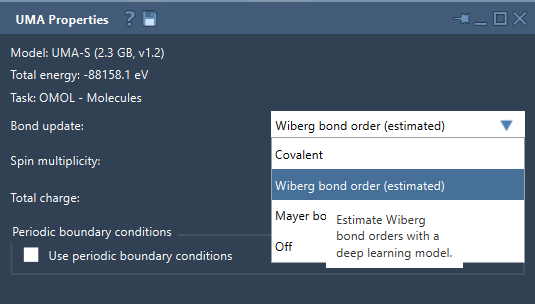
While running interactions and energy calculations in SAMSON with the UMA Force Field, the Bond Update Mode determines how SAMSON manages and visualizes the bond graph during a simulation. Here’s what each mode offers:
- Covalent: This option recomputes covalent bonds from the current structure. It ensures that bonding information is recalculated based on structural changes during the simulation. Ideal for systems where bond connectivity may evolve dynamically (e.g., reaction simulations).
- Wiberg bond order (estimated): This mode leverages a deep-learning model to estimate Wiberg bond orders. Wiberg bond order visualizations are insightful for understanding electron sharing between atoms, especially for organic systems.
- Mayer bond order (estimated): Like the Wiberg option, this estimates Mayer bond orders using deep learning. Mayer bond orders are valuable for tasks like analyzing resonance structures or exploring inorganic coordination behaviors.
- Off: No updates are made to the bond graph. This option is useful for systems where bonding does not change, or where pre-defined bonding should remain untouched during simulations.
Potential Applications in Molecular Design
The ability to dynamically adjust bond update modes can be a game-changer depending on your specific simulation goals:
- If modeling chemical reactions, choosing Covalent ensures that bonding information is always aligned with the current molecular geometry.
- For qualitative analysis of bonding (e.g., assessing bond strength or delocalization effects), selecting Wiberg or Mayer bond orders provides quick and intuitive estimates.
- Static systems, however, benefit from setting the mode to Off, ensuring computational focus is applied elsewhere without unnecessary bond recalculations.
Here’s a snapshot of the bond update options to use during your simulations:
Key Considerations When Selecting Bond Modes
Know your use case. Wiberg and Mayer bond orders are approximate visualizations based on machine learning, making them excellent for initial exploration. However, as noted in SAMSON’s documentation, important conclusions should be confirmed with more robust reference methods when necessary. The Covalent mode is particularly reliable for computational chemists working on simulations where bonding transitions are inherent to the phenomena being studied.
Integrating bond order visualization into your workflow sheds light on the qualitative interaction between atoms, providing insights into system stability, reaction readiness, and electron sharing.
Conclusion
Bond Update Modes in SAMSON’s UMA Force Field empower molecular modelers by rendering crucial bonding information accessible. Whether you are refining molecular geometries, exploring reaction pathways, or delving into bonding trends of inorganic/organic systems, these tools simplify bonding interpretations without compromising flexibility.
To explore more about SAMSON’s UMA Force Field bond-related tools and dive into further modeling possibilities, visit the original documentation page.
Note: SAMSON and all SAMSON Extensions are free for non-commercial use. You can download SAMSON from here.