



Validating and refining protein structures often involves ensuring that backbone conformations fall within energetically favorable regions. When dihedral angles (φ and ψ) are off, a residue may adopt a strained conformation that can compromise structural stability or the results of simulations. But how can you catch and fix these issues efficiently?
The Interactive Ramachandran Plot Extension in SAMSON offers a visual and interactive approach to tackle this problem—by letting you explore and edit dihedral angles directly in a Ramachandran plot, with real-time 3D updates.
Why Dihedral Angles Matter
In proteins, φ (phi) and ψ (psi) angles define the rotation of the backbone around the N–Cα and Cα–C bonds, respectively. Not all angle combinations are allowed due to steric clashes. A Ramachandran plot maps these possibilities, highlighting favorable (yellow) vs. unfavorable (white) regions.
Using the Interactive Ramachandran Plot to Refine Structures
After installing the extension from the Interactive Ramachandran Plot Extension page and restarting SAMSON, open or fetch your protein of interest. For demonstration purposes, you can use PDB ID 1YRF:
- Go to Home > Fetch.
- Enter
1YRFand hit Load.
Next, access the plot via Home > Apps > Biology > Ramachandran plot. Click Update to generate the plot based on your current structure.
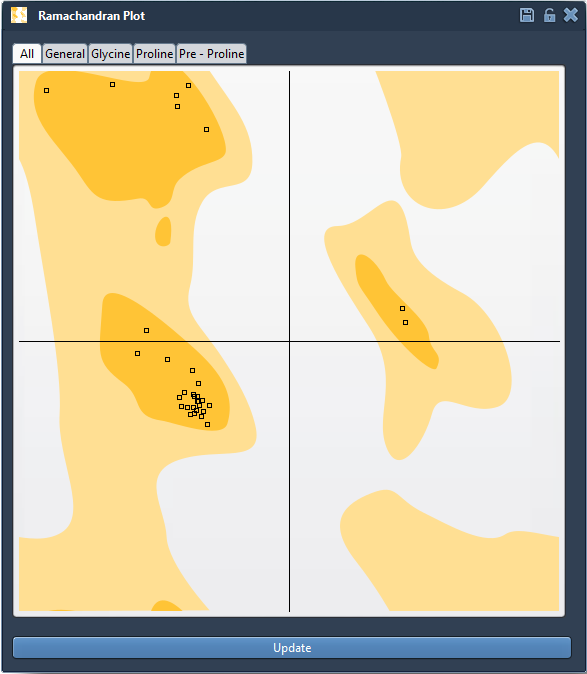
Each dot represents a residue. Favorable conformations fall in yellow areas. Tabs allow filtering by residue type (e.g., glycine, proline).
Interactive Editing: Two Ways
Option 1: Drag in the Plot
- Click and drag a dot to adjust φ/ψ angles.
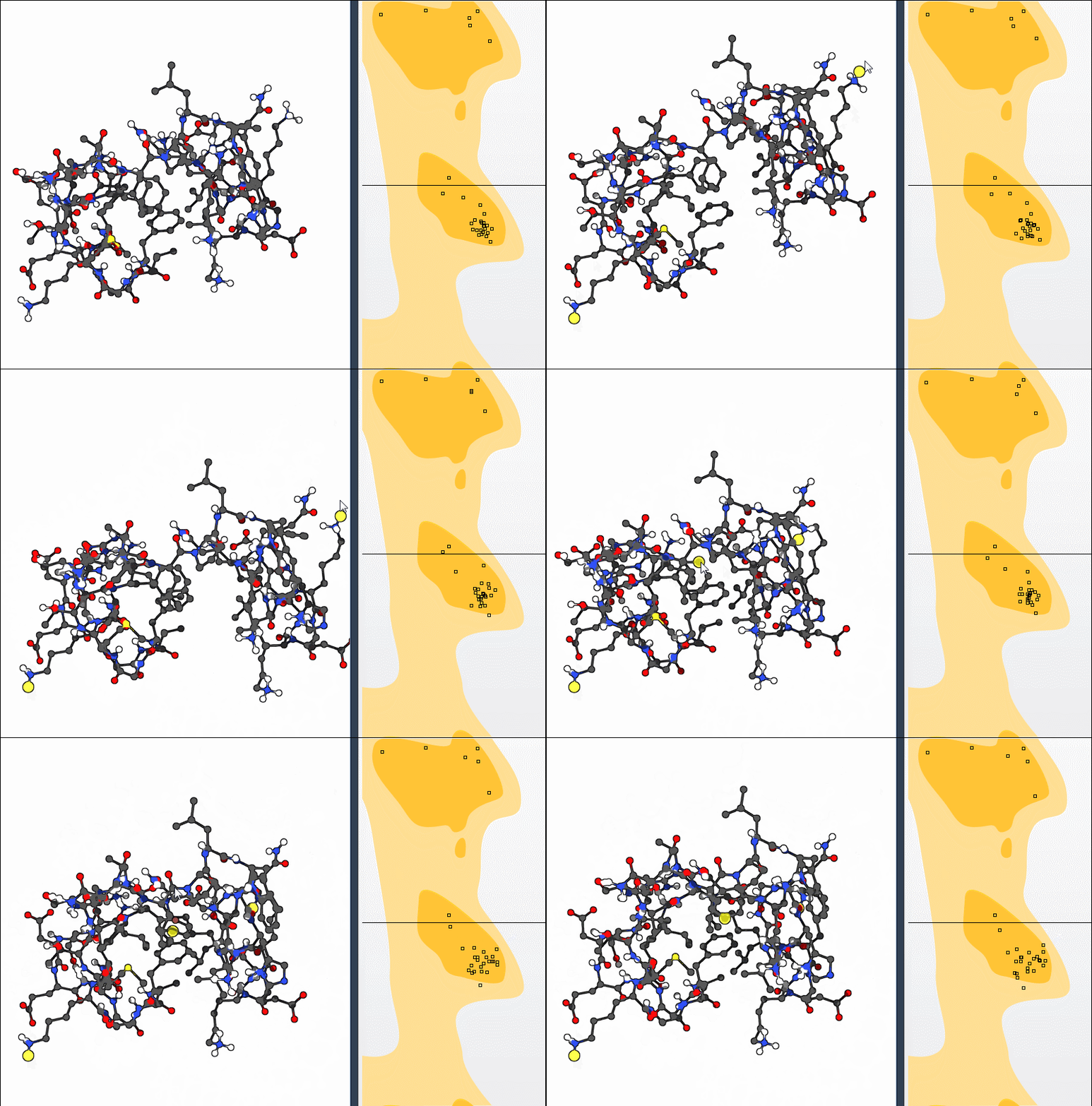
- The 3D model updates live to reflect changes.
- Undo any unwanted changes using Ctrl/Cmd + Z.
Option 2: Use the Twister Editor
Select the Twister Editor ( ) from the viewport side panel. By simply twisting the structure physically on screen, the φ/ψ values adjust accordingly, and you can observe the residue’s position shift on the Ramachandran plot.
Tweaking with Confidence
This dual approach—either plotting or twisting—gives you control over local conformation without writing scripts or entering manual angle values. It improves clarity and workflow speed when refining models before simulation.
Explore how these tools integrate into broader workflows by visiting the full documentation page.
SAMSON and all SAMSON Extensions are free for non-commercial use. You can download SAMSON at https://www.samson-connect.net.