



One of the challenges in protein modeling is evaluating and refining backbone conformations efficiently. While molecular simulations offer deep insights, visual and interactive tools can bring clarity and speed to pre-simulation structure validation.
Imagine identifying problematic residues and correcting them — just by dragging a point on a 2D plot. That’s exactly what the Interactive Ramachandran Plot in SAMSON enables you to do.
Understanding the Problem
In computational structural biology, a typical bottleneck occurs when trying to fix poor geometry: simulations may fail, or homology models are flagged with outlier residues. You often have to rely on numerical validations, then go back and tweak the structure manually — or worse, run another modeling step.
The Ramachandran Plot provides an intuitive way to visualize the ψ (psi) and φ (phi) dihedral angles of backbone residues relative to favorable conformations. Traditionally a diagnostic tool, it becomes a real-time editor in SAMSON.
How It Works
After installing the Interactive Ramachandran Plot Extension, you can:
- Open any protein (e.g., PDB ID
1YRF). - Launch the plot from Home > Apps > Biology.
- Click Update to generate the plot view.
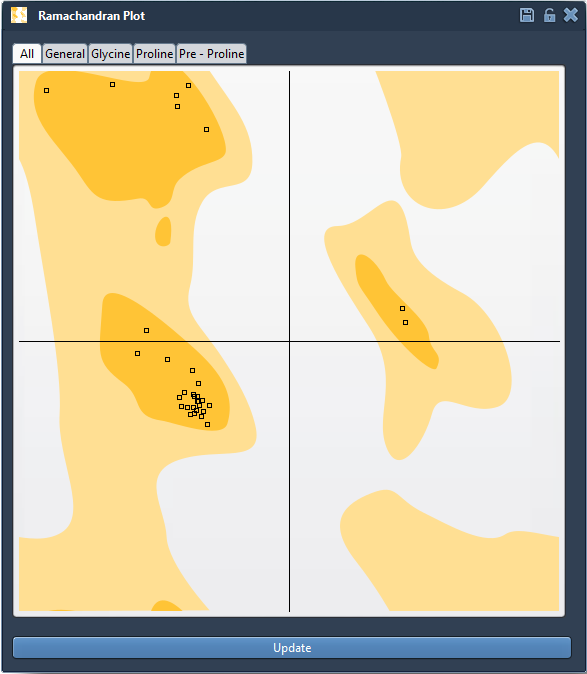
In the plot, yellow zones represent energetically favorable conformations; white zones are unfavorable. Each dot represents a residue. Click a dot to focus on it — the residue will be highlighted in the 3D structure, and φ and ψ values appear in the status bar:

Refining Conformations – Two Ways
1. Drag to Edit
Click and drag a dot to a new location in the plot. As you move it into a yellow zone, the corresponding backbone conformation in the 3D structure updates live. No guesswork. Just move and watch.
You can always press Ctrl / Cmd + Z to undo if needed.
2. Twist in 3D
If you prefer to manipulate the structure visually, use the Twister Editor:
- Select the Twister Editor from the left-hand toolbar.
- Twist backbone torsions directly in the 3D viewport.
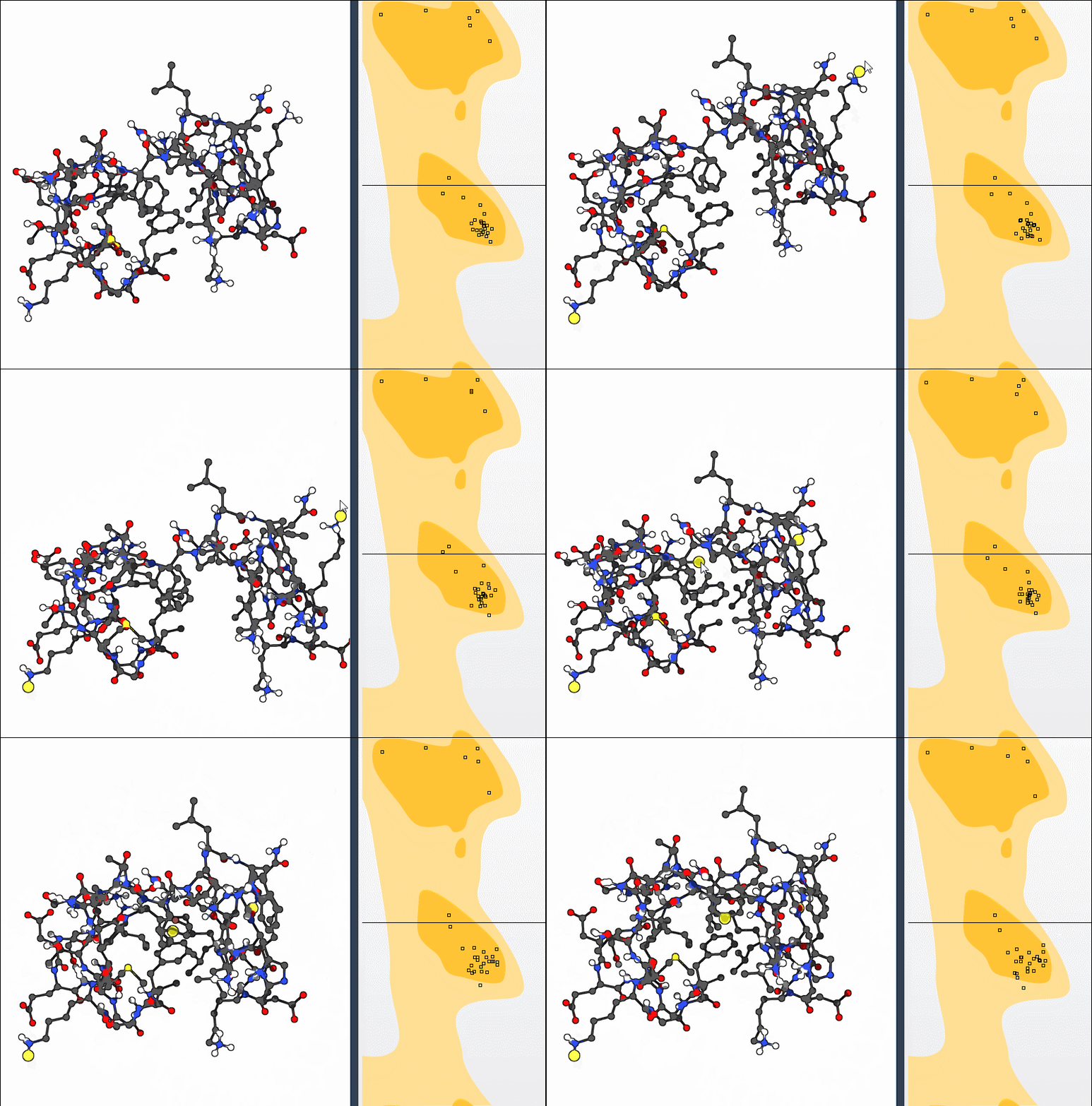
- Watch the Ramachandran plot update live as you adjust.
Why It Matters
This interactivity means fewer back-and-forth steps. You can refine problematic regions before simulations, correct homology model outliers, or simply learn more about structural flexibility by actively exploring angle ranges.
Visual learners and experimental biologists often benefit from intuitive tools. This feature bridges interactive modeling with insightful validation.
Limitations to Keep in Mind
Manual adjustments may still introduce strain, so it’s recommended to follow up with energy minimization or structural validation steps. However, as a quick refinement tool, this is remarkably helpful.
To explore more features and refine your structural models visually, visit the full documentation page: https://documentation.samson-connect.net/tutorials/ramachandran/ramachandran-plot/
SAMSON and all SAMSON Extensions are free for non-commercial use. You can get SAMSON at https://www.samson-connect.net.