



One of the most common hurdles in molecular modeling arises when a user attempts to edit a structure interactively and ends up frustrating the system—bonds don’t break, new atoms refuse to connect, or the energy landscape becomes unstable. If you’ve ever struggled with force fields that won’t adapt to your changes, you’re not alone.
This is where the Interactive Modeling Universal Force Field (IM-UFF) shines. It’s designed specifically to allow for smooth, real-time topological changes while preserving important physical properties during simulations. This means you can move atoms around, break or form bonds, and adjust molecular geometries without having to stop and restart simulations or re-parameterize systems.
What is Topology in Molecular Modeling?
Topology refers to how atoms are connected—through single, double, or triple bonds, or not at all. Traditional force fields like UFF are usually defined for systems with fixed topology: you define the bond network once, and it doesn’t change. But in interactive modeling (e.g., dragging atoms with your mouse), you’d expect bonds to potentially break or form based on proximity and chemistry.
Introducing IM-UFF for Interactive Simulation
IM-UFF extends the original Universal Force Field to support dynamic topology. That means it can:
- Break bonds when atoms are moved far apart
- Form new bonds when atoms are brought close together
- Adapt atom types and bond orders continuously based on current geometry
This is particularly useful not just for visualization but also for interactive system building, reaction pathway exploration, or educational purposes where ease of manipulation is essential.
How Does It Work in Practice?
Once the IM-UFF interaction model is selected in SAMSON, you can start a simulation where forces guide the structure into physically meaningful configurations. Here’s what happens:
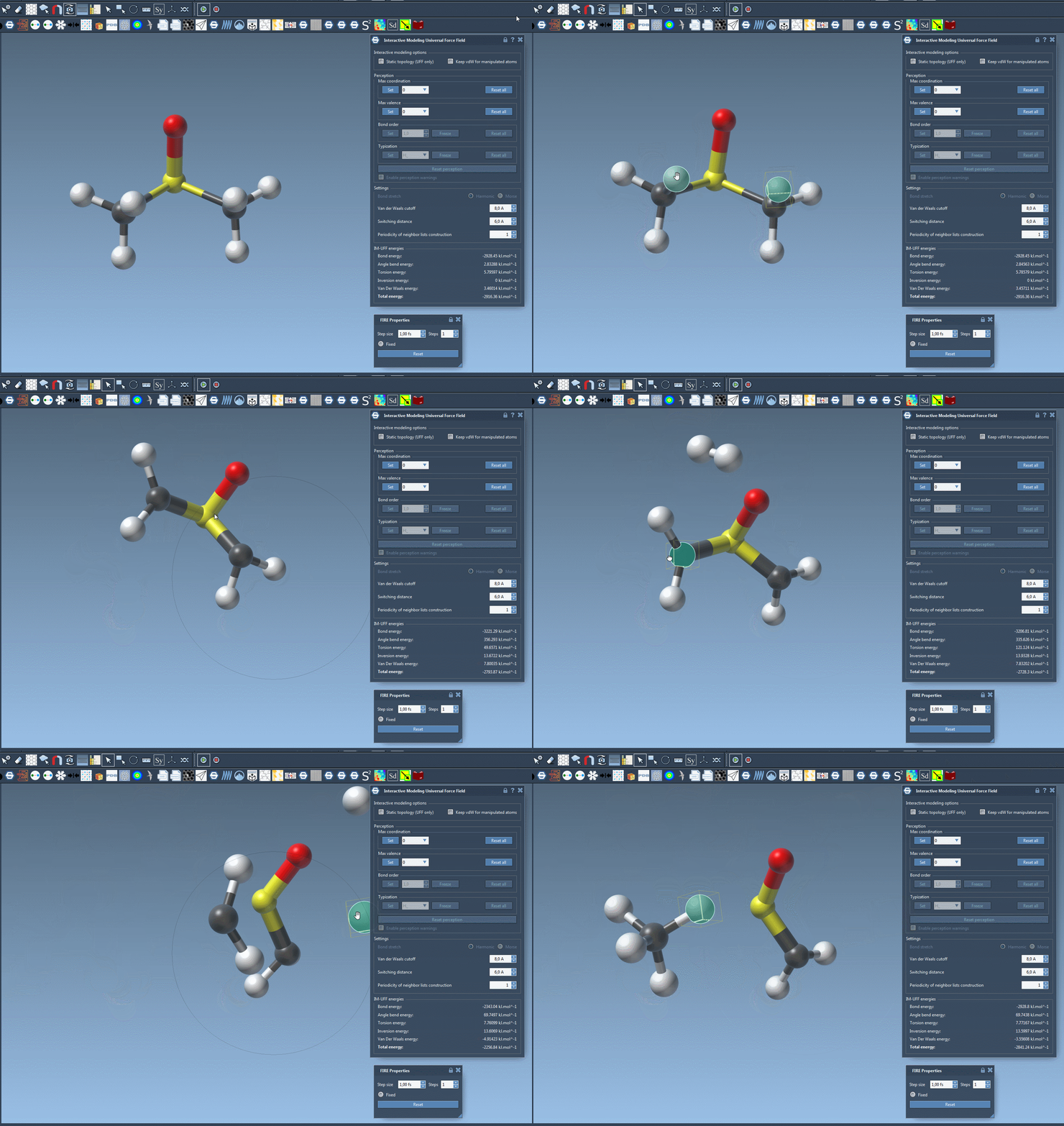
- Moving an atom slightly will result in elastic deformation — bonds stretch, but the topology is preserved.
- Pull an atom far enough, and the bond will break.
- Move it near other atoms, and new bonds might form based on geometric and chemical criteria.
This dynamic behavior is controlled by the parameter panel where you can toggle:
- Static topology (UFF only): When enabled, the topology does not change, mimicking standard UFF behavior.
- Keep vdW for manipulated: Helps with atom placement by disabling van der Waals interactions for atoms under manipulation.
Visual Example
Below, you can see IM-UFF in action. Atoms are interactively moved: bonds break, form, and the energy updates in real time. This type of feedback is crucial for building complex structures or understanding structural dynamics without switching tools or representations.
Why It Matters
If you’re designing molecules from scratch, fine-tuning a geometry, or teaching concepts like bond formation, IM-UFF lets you work more fluidly. Traditional force fields can feel rigid because they can’t handle real-time topology edits — but with IM-UFF, you gain a layer of expressiveness and control that aligns with the way chemists think and work.
Best of all, you don’t have to compromise on accuracy or performance, as IM-UFF is built upon the established UFF framework with thoughtful extensions for interactivity.
Want to dive deeper? You can read the full tutorial and learn how to customize settings at: https://documentation.samson-connect.net/tutorials/uff/im-uff/
SAMSON and all SAMSON Extensions are free for non-commercial use. You can download SAMSON here.