Skip to content
YouTube Twitter RSS AboutMe Mail
SAMSON Blog
Skip to content
  • Latest posts
  • Get SAMSON

Author: OneAngstrom

Quickly Filter Chains by Size and Composition in SAMSON

OneAngstrom

When dealing with large biomolecular structures, one of the common pain points for molecular modelers is simply finding the parts of the model they want to work with. Whether you want to isolate specific chains, target macromolecules of interest, or…

Refining Molecular Transition Paths in Parallel—Without the Headache

OneAngstrom

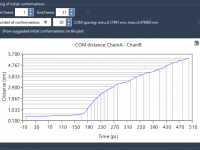
When studying molecular mechanisms—such as ligand unbinding or chemical reactions—it’s often not enough to know just the starting and ending molecular structures. Molecular modelers need to understand the transition path a molecule follows between states, particularly through areas around the…

Keeping Your Eye on the Molecule: Following Atoms in SAMSON

OneAngstrom

When exploring molecular systems, staying focused on the part of the system that matters most can be surprisingly difficult. Molecules twist, fold, and shift in complex choreography, and during an animation it’s easy to lose sight of the biologically or…

Making Molecules Appear When You Need Them: A Closer Look at the Shown Animation in SAMSON

OneAngstrom

When preparing animations of molecular systems, one common challenge researchers face is how to manage visibility transitions without manually toggling the display of each component. Whether you are illustrating a protein domain suddenly becoming relevant in a binding event or…

Why Your Molecular File Won’t Open (And What to Do About It)

OneAngstrom

Anyone who has ever worked with molecular modeling software has likely run into this: a file that should open, but doesn’t. Maybe it’s a structure downloaded from a public database. Maybe it’s data from your collaborator’s cryo-EM experiment. Whatever the…

Optimizing Molecular Transitions with P-NEB: A Step-by-Step Guide for Modelers

OneAngstrom

Identifying the minimum energy path between two molecular conformations is a fundamental task in molecular modeling. Whether you’re studying ligand unbinding, conformational rearrangements, or molecular switching, knowing how molecules move from one state to another—the so-called transition path—is key. However,…

Making Molecular Flythroughs: A Practical Guide to Camera Animation in SAMSON

OneAngstrom

Creating compelling and clear molecular presentations can be challenging—especially when you need to guide your audience through 3D molecular structures. One frequent pain point among molecular modelers: how to make the camera smoothly move through scenes and align precisely with…

Why Add Custom Index Groups in GROMACS—and How to Do It Easily in SAMSON

OneAngstrom

One of the small but persistent frustrations when working with GROMACS is managing index groups—especially when preparing for analyses that require specific selections such as pull groups, regions of interest, or structural motifs like alpha helices. Default index groups are…

Creating Pulsing Molecular Visuals in SAMSON: A Step to Better Presentations

OneAngstrom

Clarity and visual engagement are key when communicating complex molecular structures and mechanisms. But making your molecular presentations dynamic without overwhelming your audience can be tricky. That’s where the Pulse animation in SAMSON comes in handy. If you’ve ever wanted…

Tired of Predefined Units? Register Your Own Monomers Easily

OneAngstrom

When working on polymer design, especially in computational research or simulations, many molecular modelers run into the same issue: limited library content. You often need to create polymers based on specific monomer units tailored to your system — but hardcoding…

«‹106107108109110›»
  • Subscribe for tips and news

    Check your inbox or spam folder to confirm your subscription.

  • About
  • Privacy Policy
  • Terms of use
  • Contact us
  • Twitter
  • Facebook
  • Back to Top
Powered by Nirvana & WordPress.