



In traditional molecular modeling workflows, editing structures often means stopping the simulation, changing the topology manually, and restarting the process. This interrupts modeling intuition and introduces friction, especially during rapid prototyping or educational demonstrations. Wouldn’t it be more natural to push or pull atoms and watch chemical bonds adjust in real-time — just like manipulating a physical model?
That’s exactly what the Interactive Modeling Universal Force Field (IM-UFF) offers in SAMSON. This force field not only simulates systems based on physical interactions, it also allows topology — such as bond creation and breaking — to update automatically as atoms are displaced.
What is Interactive Modeling with IM-UFF?
IM-UFF is an extension of the original Universal Force Field (UFF), designed to handle dynamic structural changes during simulations. It considers forces between atoms, while allowing users to manipulate atoms directly with mouse interactions. This makes it possible to explore structural alternatives without stopping the simulation.
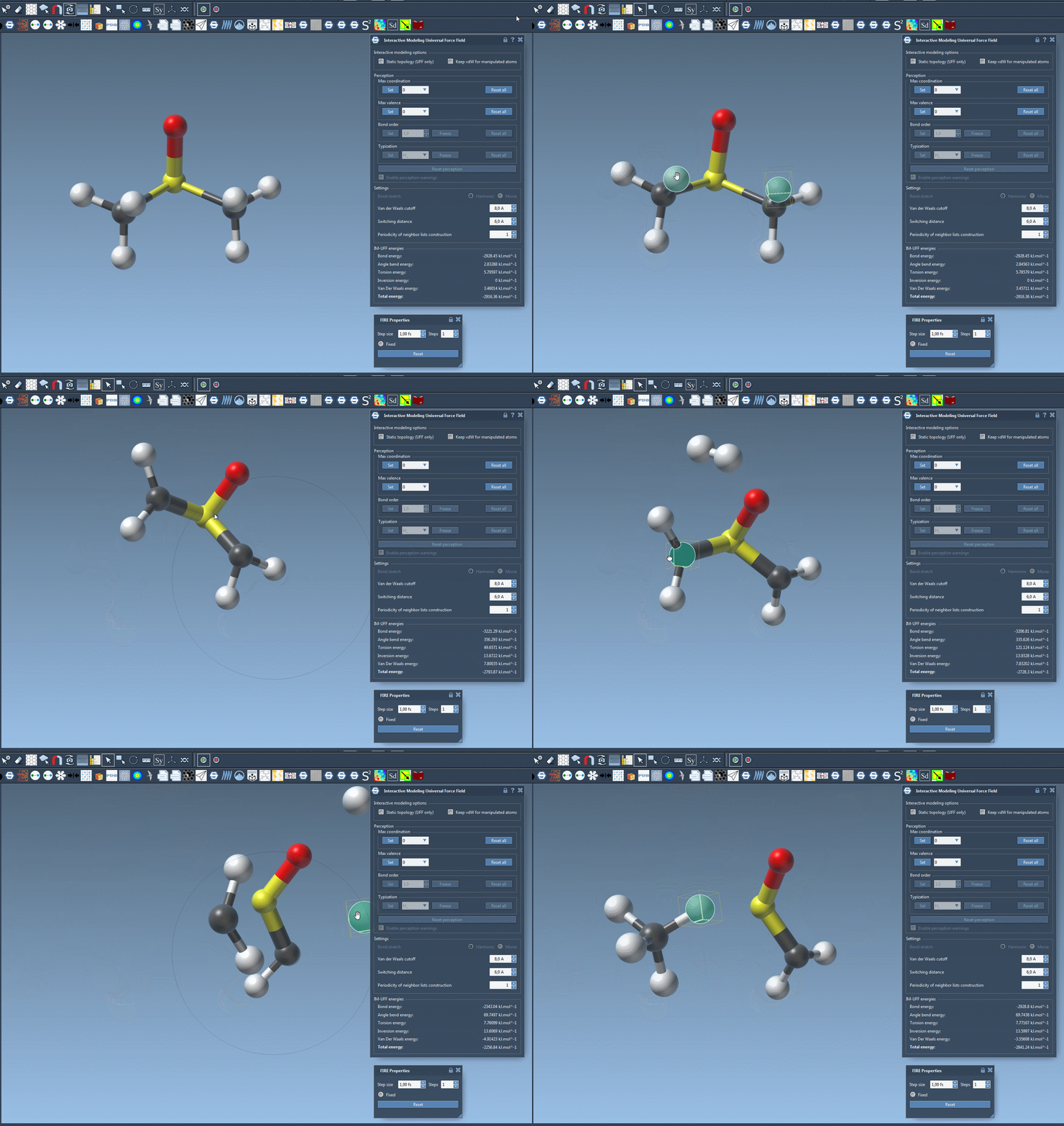
For example, if you move an atom slightly, existing bonds remain intact and the geometry adjusts smoothly. But if you move an atom far enough, the system recognizes the bond stretch and breaks the connection. Conversely, placing an atom near suitable neighbors allows new bonds to form. The bond orders, atom types, and overall topology update continuously.
When Can This Be Useful?
- Sketching new molecules by dragging atoms together and watching stable bonds form.
- Teaching chemistry concepts like bond formation/breaking using direct interaction, rather than static diagrams.
- Exploring reaction mechanisms by simulating the geometric evolution of a system through atom displacements.
How to Try It
To begin using IM-UFF in SAMSON:
- Open a molecular system document.
- Go to Edit > Simulate > Add simulator (or use
Ctrl+Shift+M / Cmd+Shift+M). - Choose Interactive Modeling Universal Force Field from the list.
- Select a state updater like FIRE.
- Click OK.
The parameter window will appear. To ensure topology can change during manipulation:
- Uncheck Static topology (UFF only).
- Uncheck Keep vdW for manipulated, if you want atoms being dragged to ignore van der Waals repulsions, allowing easier connections.
Once the simulation starts (Edit > Simulate > Start), you can displace atoms and observe dynamic topological transformations in real time.
Fine-Tune Your Experience
IM-UFF also supports customization. When dynamic topology is enabled, bond orders and atom types are derived from atomic positions, enabling smooth transitions. For more advanced control over interaction parameters (like van der Waals cutoffs), you can refer to the UFF interaction model documentation.
This capability to intuitively and interactively refine molecular designs may save time, especially for researchers sketching early-stage molecules or exploring structural responsiveness.
To learn more about the IM-UFF interaction model and try it yourself, visit the full documentation here: https://documentation.samson-connect.net/tutorials/uff/im-uff/
SAMSON and all SAMSON Extensions are free for non-commercial use. You can download SAMSON at https://www.samson-connect.net.