



Designing molecular systems with lipid layers around proteins can be challenging for molecular modelers, especially when striving for precision and non-overlapping molecular arrangements. The Molecular Box Builder extension in SAMSON offers an efficient way to create these systems with ease. Whether you’re working on membrane protein simulations, molecular assemblies, or related research, this tool can be a game-changer. Let’s explore how to build a lipid layer around a protein step by step.
Why Build Lipid Layers Around Proteins?
Lipid layers are essential for studying membrane proteins in their native-like environment. Without integrating these lipid bilayers, understanding the behavior, stability, and interactions of these proteins becomes less realistic. Traditional methods for generating such systems can be time-intensive and complex, but Molecular Box Builder simplifies the process to a few straightforward steps.
Step-by-Step Guide
Step 1: Align the Protein
Getting the protein correctly aligned is crucial for ensuring an evenly distributed lipid layer. The following steps help align the protein:
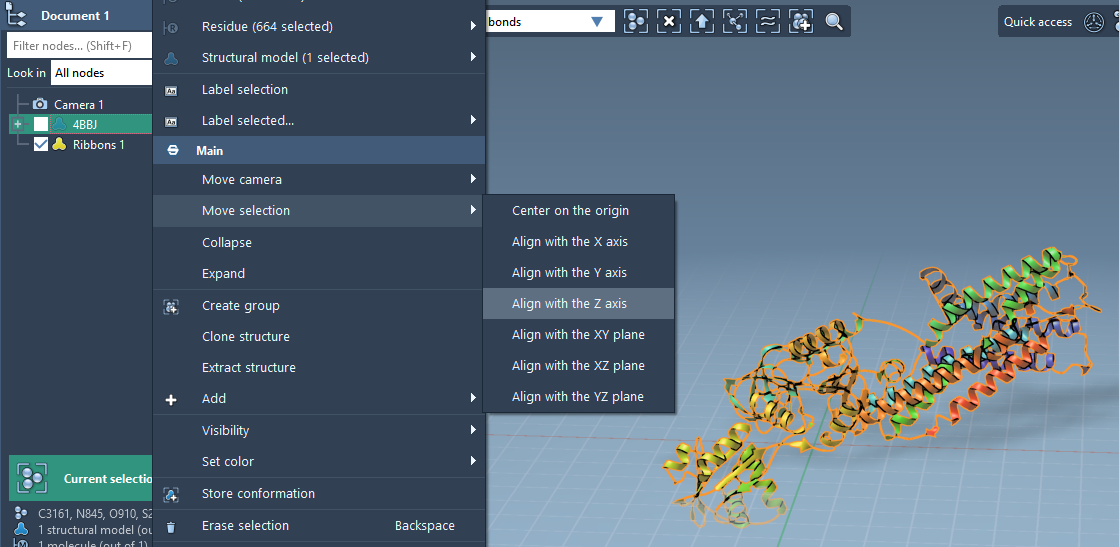
- In the Document view, right-click the protein to access the context menu.
- Select: Move selection > Align with Z axis.
- Then, click: Move selection > Center on the origin.
This reorientation positions the protein optimally for building surrounding lipid layers.
Step 2: Set the Lipid Molecule
Once the protein is aligned, it’s time to prepare the lipid molecule for the layer:
- Import a lipid molecule (e.g., a phospholipid).
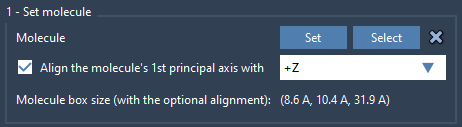
- Select the lipid molecule and click Set to register it in the Molecular Box Builder.
- Optionally, align the lipid’s principal axis to the
+Zaxis for consistency.
Step 3: Define the Box
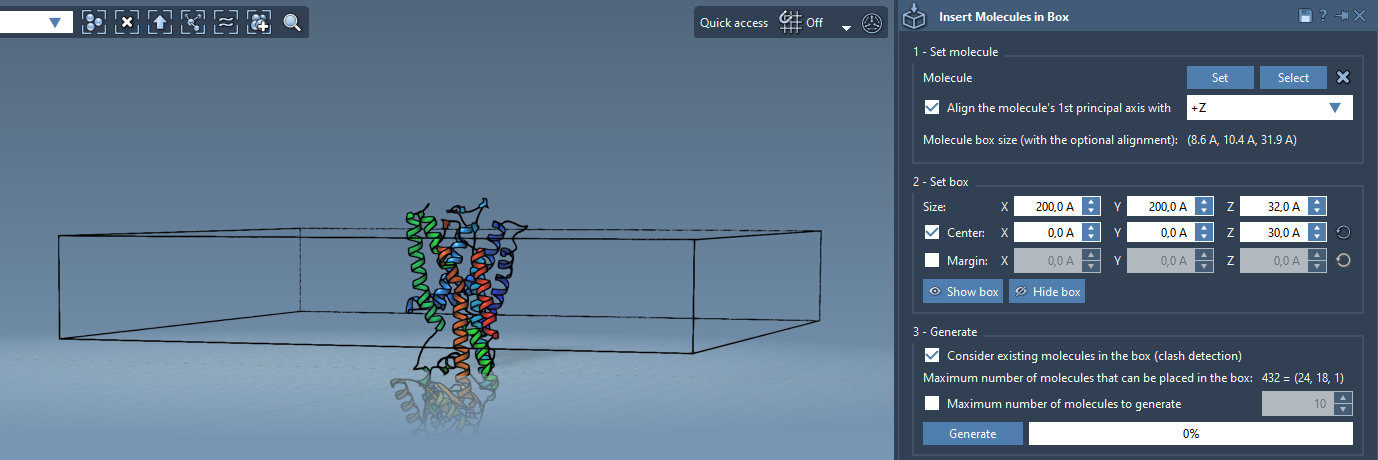
Next, define a 3D box that will act as the container for your lipid layer:
- Center the box around the aligned protein.
- Adjust the size of the box to contain a single lipid layer around the protein. This can be done by manually setting the box dimensions in
X,Y, andZ. - If necessary, set the margin between inserted molecules to avoid overlaps.
Step 4: Generate the Lipid Layer
With the protein aligned, lipid molecule set, and the box defined, it’s time to generate the lipid layer:
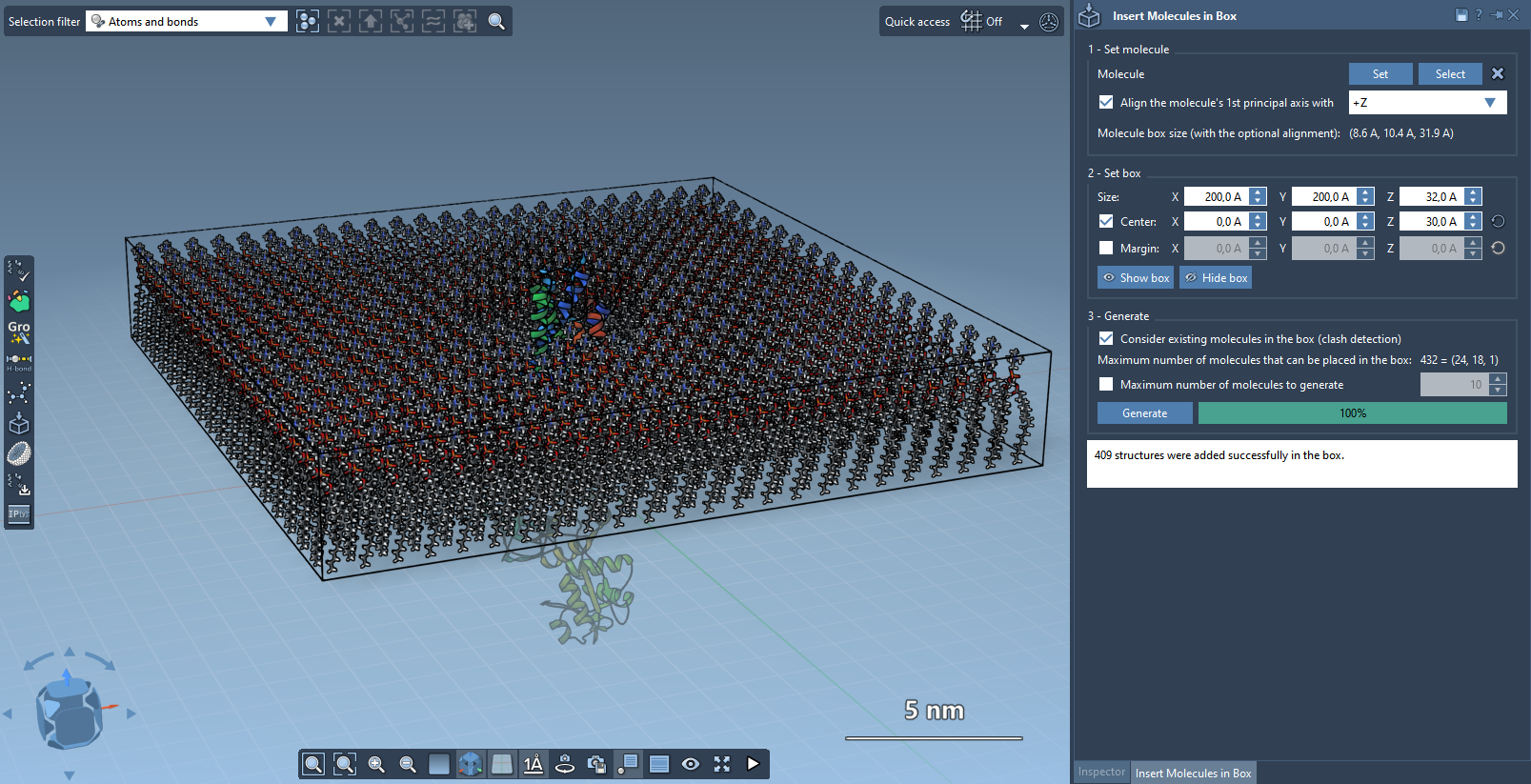
- Enable Consider existing molecules in the box so that lipids only occupy the available space.
- Click Generate. The Molecular Box Builder calculates the molecular placement to ensure proper arrangement.
The result is a single lipid layer evenly distributed around the protein.
Optional: Build a Lipid Bilayer
If needed, you can extend your lipid system into a bilayer:
- Create the first layer with
+Zalignment. - Move the box center slightly along the
Z-direction to create space for the second lipid layer. - Add the second layer with
-Zalignment.
The result is a symmetric lipid bilayer system ideal for a wide range of simulations.
Conclusion
Generating lipid layers or bilayers around proteins no longer has to be a tedious task. With Molecular Box Builder, you can achieve precise molecular assemblies quickly and efficiently. This feature, along with other capabilities of SAMSON, provides molecular modelers robust tools for building realistic models of membrane systems.
For a more detailed explanation, visit the complete documentation at https://documentation.samson-connect.net/tutorials/molecular-box-builder/molecular-box-builder/.
*Note: SAMSON and all SAMSON Extensions are free for non-commercial use. Discover SAMSON at https://www.samson-connect.net.