



Designing membrane-like environments for molecular simulations can be a challenging task for molecular modelers. For instance, creating lipid layers around proteins with a suitable configuration often involves tedious manual steps. If you can relate to this challenge, you’ll be excited to learn how the Molecular Box Builder in SAMSON can streamline this process. Whether you’re studying membrane proteins or modeling lipid bilayers, the tool offers a simple, efficient workflow for building lipid layers around proteins. This post will guide you through the process.
Why Build Lipid Layers Around Proteins?
Protein-membrane systems are vital in many biological processes, and accurately modeling them often requires constructing lipid layers or bilayers. This setup helps researchers understand structural integrity, interactions, and dynamics at the molecular level. However, generating such configurations manually can be error-prone, not to mention time-intensive.
Streamlined Workflow with Molecular Box Builder
The Molecular Box Builder, available within SAMSON, drastically simplifies building lipid layers. Below, we break the workflow into fundamental steps with illustrative examples to help you get started:
Step 1: Align the Protein
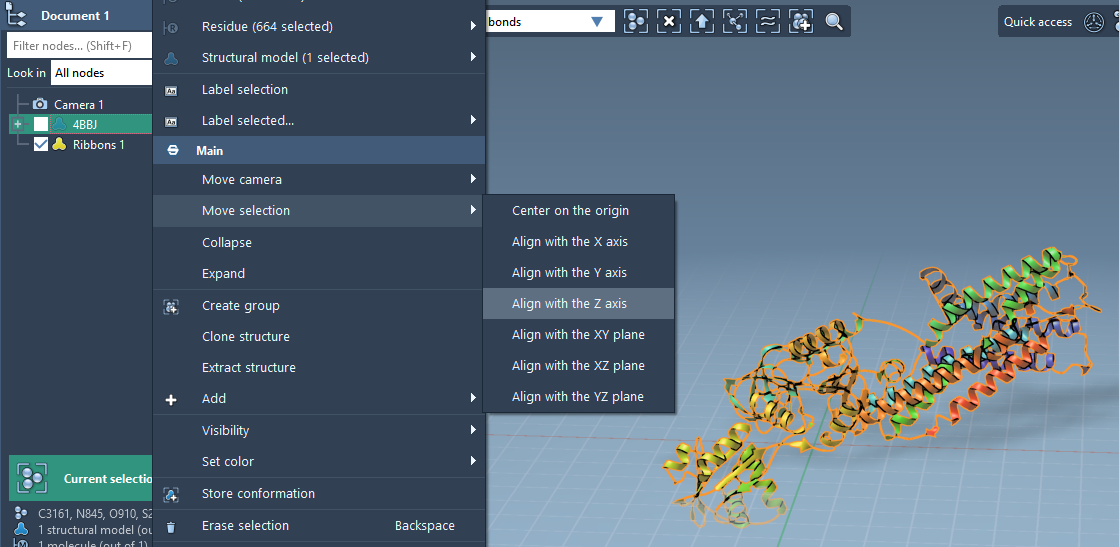
The first step in creating a lipid layer around a protein is ensuring that the protein is properly oriented and centered. Here’s how you can achieve this in SAMSON:
- Right-click the protein in the Document view.
- In the context menu, select Move selection > Align with Z axis to align the protein principal axis with the Z-axis.
- Then, choose Move selection > Center on the origin to position the protein conveniently.
Step 2: Set the Lipid Molecule
After aligning your protein, you need to import a lipid molecule that will make up your lipid layer:
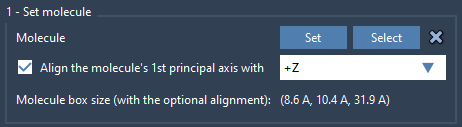
- Import a lipid molecule (e.g., phospholipids like POPC).
- Select the lipid molecule and click Set in the Molecular Box Builder app.
- Align the lipid’s principal axis to the
+Zaxis for appropriate orientation within the membrane system.
Step 3: Define the Box
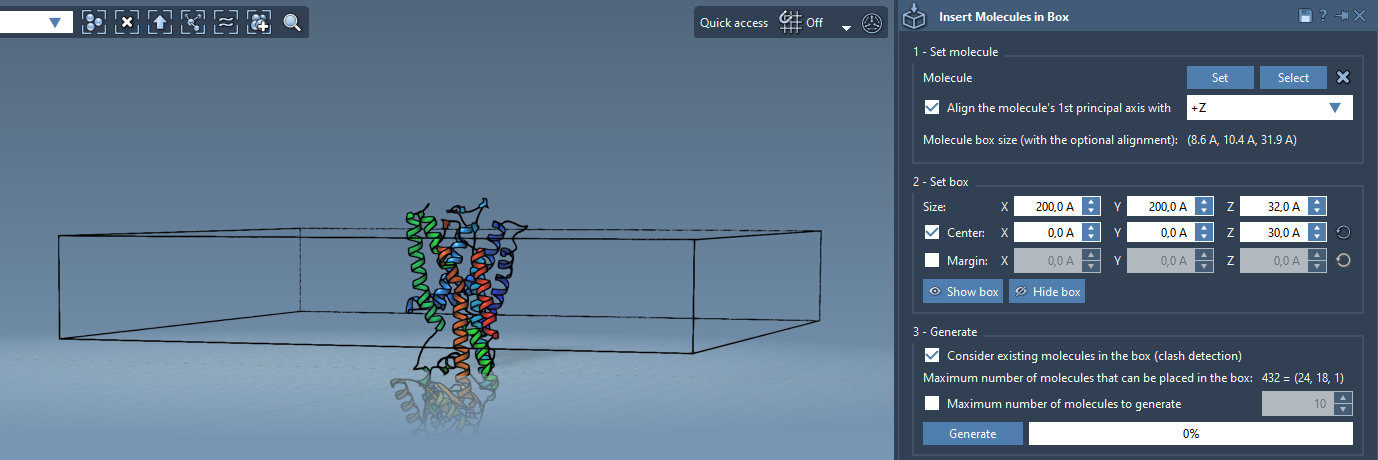
The next step is defining the box that will contain the lipid layer and your protein:
- Center the box around the protein to ensure an even distribution of lipids.
- Set dimensions big enough to contain a single lipid layer (you can visually inspect and fine-tune these parameters).
- Adjust the margin between molecules to account for the desired spacing within the lipid layer.
Step 4: Generate the Lipid Layer
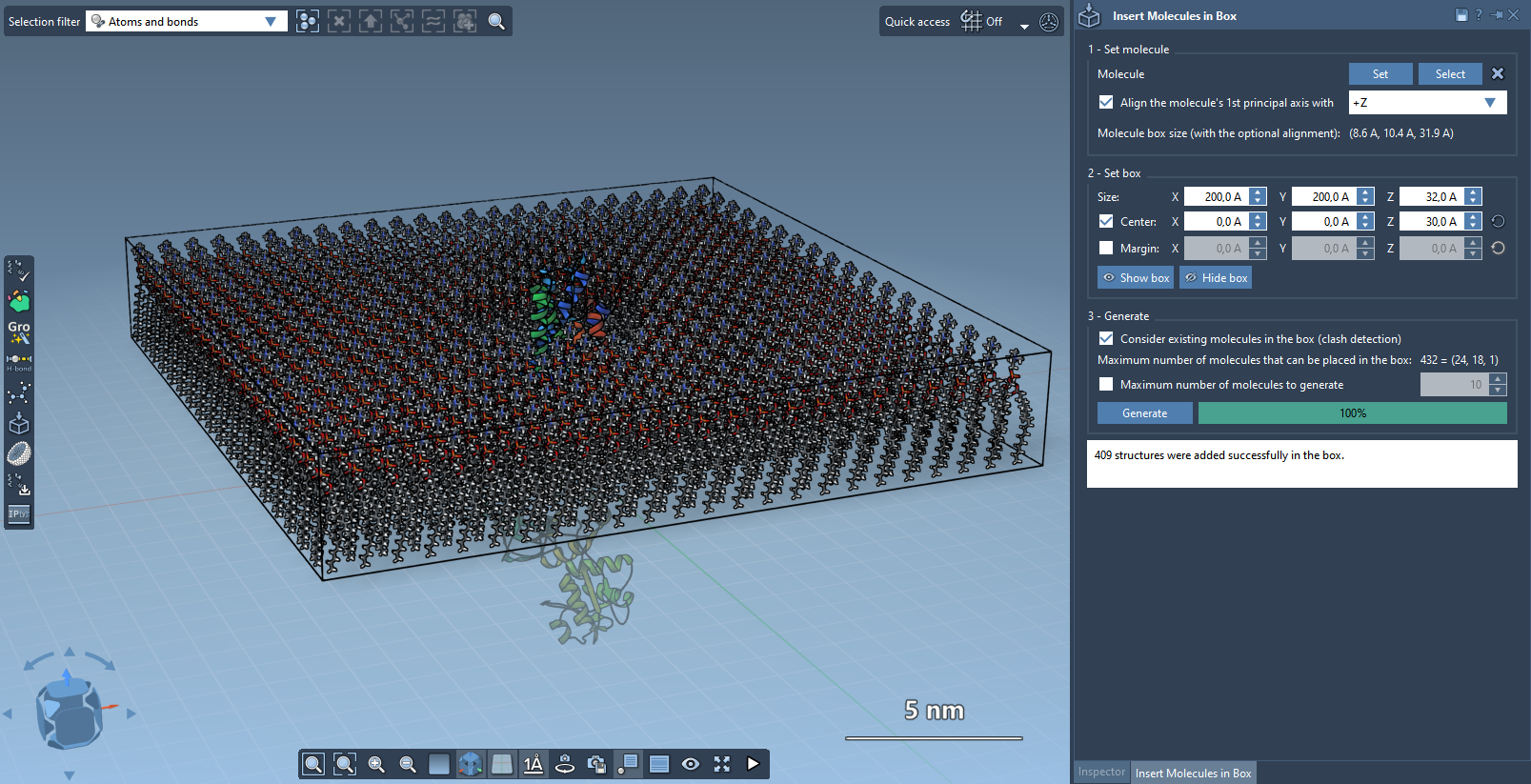
Once the box is defined, you can use the Molecular Box Builder to populate it with oriented lipid molecules:
- Enable the Consider existing molecules in the box option, so the tool places lipids only in the available space around the protein.
- Click Generate. In seconds, the app will create a lipid layer around the selected structure.
And just like that, you’ll have a single-layered lipid system:
Optional: Creating a Lipid Bilayer
For a full lipid bilayer, you can follow these additional steps:
- Add the first lipid layer with the
+Zalignment. - Shift the box center along the Z-axis and add a second layer with the
-Zalignment.
This process allows you to construct biologically accurate bilayer systems that are ready for minimization and simulation.
Next Steps
Once you’ve generated the lipid-protein system, you can minimize, equilibrate, and simulate it using tools such as the GROMACS Wizard. For detailed steps, check out this documentation page to learn more.
Note: SAMSON and all SAMSON Extensions are free for non-commercial use. Download SAMSON at SAMSON Connect.