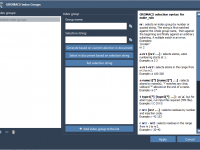
If you’ve ever run GROMACS simulations, you probably know that defining the right index groups can be crucial. Whether you’re setting up pulling groups for umbrella sampling, customizing restraints, or extracting specific analysis from your trajectory, index groups give you…
When working on complex molecular models in SAMSON, it’s easy for your screen to become cluttered—especially when multiple labels are displayed. Whether you’re tracking molecular IDs, distances, or other annotations, label visibility can quickly become overwhelming. What if there was…
When exploring conformational transitions in proteins, it’s tempting to dive straight into sampling and path search. But many molecular modelers have encountered a frustrating issue: unrealistic or noisy paths that seem physically implausible. A common cause? Skipping proper energy setup…
When working with molecular models, clarity is key. Whether you’re preparing figures for a publication, presentations, or just trying to keep track of complex systems, proper labeling of atoms, residues, or molecules can be the difference between insight and confusion.…
Launching molecular dynamics simulations can be resource-intensive, particularly for large systems. If you’ve ever struggled with local hardware limitations when using GROMACS, you’re not alone. A common frustration among molecular modelers is the inability to test a system before committing…
In molecular modeling presentations, clarity is key. Whether you’re showing structural rearrangements, highlighting specific regions, or simplifying a complex scene, hiding certain parts of your molecular model can greatly help your audience stay focused. But removing components abruptly can be…
Preparing molecular systems for simulations typically involves several steps, and one of the persistent pain points for many molecular modelers is selecting the correct input files at each stage—especially during equilibration. Do you find yourself digging through folders, unsure which…
Molecular animations can turn complex scientific data into clear visual narratives. Whether you’re assembling molecular systems, explaining docking mechanisms, or preparing a captivating presentation for a lecture or a publication, camera motion is what brings your story to life. But…
When working with complex biomolecular structures, modelers often face the challenge of quickly identifying and operating on specific parts of the system. Whether it’s filtering out very small fragments or focusing on large, meaningful segments, being able to express these…
If you’ve ever spent time converting molecular systems between different file formats just to open them in various tools, you’re not alone. For molecular modelers working with crystallography data, MD simulations, mesh geometries, or even animations, incompatible formats can be…