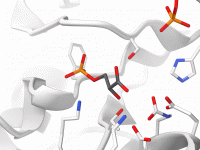
Creating compelling and clear scientific visuals can be a challenge for molecular modelers. Whether you’re preparing a presentation, sharing your latest findings, or teaching students about molecular structures, you want your audience to understand the spatial arrangement of atoms—without needing…
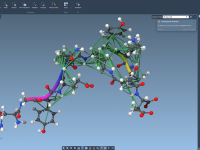
One of the first tasks after building or importing a molecular structure is preparing it for simulation. But here’s a common dilemma faced by many molecular modelers: the geometry looks mostly correct, there are only subtle non-idealities, but running a…
When setting up molecular dynamics simulations with periodic boundary conditions in GROMACS, one of the first steps is defining the unit cell shape. This decision directly affects the computational efficiency of your simulation and how well it reflects your system’s…
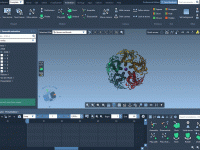
When creating molecular animations, clarity of movement can often make or break your visualizations. A common challenge faced by molecular modelers and educators is how to move both the camera and its focal point vertically through a scene without distorting…
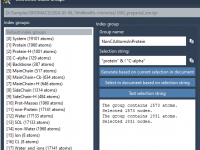
When fine-tuning a molecular dynamics workflow, being able to define your own atom groups — for pulling, analysis, or restraints — is incredibly important. GROMACS nudges you in the right direction by generating standard index groups automatically, such as Protein,…
When working on optimizing small molecules for better binding affinity or selectivity, one often faces the question: What happens if I replace or attach something at this position? Trial-and-error can be time-consuming, and manual modifications in 3D editors are prone…
When presenting molecular models—whether in research talks, educational content, or collaborative reviews—clarity is key. A common hurdle in visual storytelling is how to draw attention to important structures without cluttering the scene or drowning your audience in static visuals. This…
One of the most common issues molecular modelers face is importing structural data. Whether you’re working with protein models, small molecules, or volumetric datasets like electron densities, dealing with different file formats can be frustrating and time-consuming. Lack of format…
Specifying the binding site in protein-ligand docking simulations is often one of the most critical — and error-prone — steps in preparing a reliable docking study. Whether you’re working with co-crystalized structures or docking into an apo form, identifying the…
If you’ve ever asked yourself, “Where did my node go?” while working in SAMSON, you’re not alone. Molecular modelers, especially those building complex systems with numerous nested components, often run into confusion when parts of their structure appear to be…