One of the powerful features of the SAMSON platform is its extensibility through SAMSON Extensions—modular tools that enhance the capabilities of your molecular modeling workflow. Whether you’re interested in machine learning models for protein folding, advanced visualization tools, or simulation…
Have you ever placed labels to annotate atoms, residues, or molecules in your SAMSON model, only to see them vanish as you zoom out? This can be frustrating, especially when preparing visuals or sharing interactive models. Fortunately, there’s a systematic…
When working with complex molecular models in SAMSON, adding notes to nodes can be a convenient way to annotate and keep track of specific elements or structural features. However, as the number of notes increases—especially in collaborative or long-term projects—it…
When analyzing or designing molecular systems, selecting specific types of atoms quickly and precisely can save a lot of time and reduce errors. One of the frequent needs among molecular modelers is to isolate aromatic atoms across complex molecular structures.…
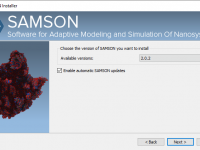
If you’re a molecular modeler working in a highly specific environment—whether you’re replicating previous results or using plugins that only support certain versions—it can be essential to install an older version of SAMSON. The good news? SAMSON provides a clear…
When you’re modeling large biomolecules, it’s not uncommon to find yourself overwhelmed by the number of elements in your scene—atoms, residues, chains, backbones, materials, and more. Sometimes all you want is to quickly isolate certain backbone fragments, say, those with…
Working on complex molecular systems often means jumping back and forth between different parts of a structure—ligands, receptors, water molecules, or specific chains. Manually reselecting these parts again and again is time-consuming and can break your flow. That’s where Quick…
In computational molecular modeling, trial and error is often part of the discovery process. Whether you’re building a structural model, setting up a simulation, or analyzing a complex interaction, it’s common to make adjustments—some of which you’d rather undo. But…
Preparing a coarse-grained system for molecular dynamics (MD) simulations can be surprisingly tricky — especially when it comes to solvation. When you’re using MARTINI v.3.0.0 force field models in SAMSON’s GROMACS Wizard, one of the most frustrating issues you might…
Molecular modelers and educators often face the challenge of communicating dynamic processes effectively—like binding events, conformational changes, or molecule appearances during reactions. In molecular animation, when and how certain elements appear or disappear can make a big difference in how…