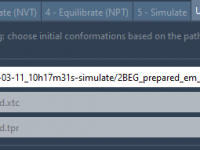
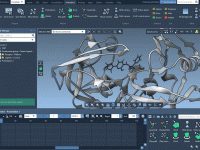
Generating initial conformations for umbrella sampling can be time-consuming, especially for researchers who already have a simulation trajectory and want to reuse it efficiently. If you’re using SAMSON’s GROMACS Wizard, there’s a streamlined and visual way to set this up…
Setting up a molecular mechanics simulation can feel like preparing for a journey with no map—especially when working with customizable force fields like the Universal Force Field (UFF). If you’ve ever hesitated because you weren’t sure how to initialize UFF…
Molecular modelers often deal with large datasets containing various conformations of molecules. One common task is filtering conformations based on the number of atoms—whether to identify large supramolecular assemblies, focus on smaller fragments, or prepare subsets for simulation. But scrolling…
One of the surprisingly common pains molecular modelers face is interpolating the motion between two conformational states of a macromolecular complex when those structures differ in the number of atoms or residues. Even small differences can impede trajectory generation, especially…
Running a molecular dynamics (MD) simulation is a critical step in exploring the dynamic behavior of molecular systems like proteins, membranes, or drug candidates. But once the simulation ends, the next challenge can feel just as important — making sense…
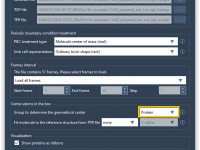
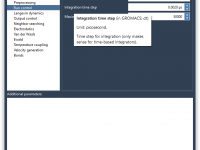
For many molecular modelers using GROMACS, customizing simulations often means diving into .mdp files and adjusting text-based parameters manually. While this gives flexibility, it can also be error-prone and lacks visual guidance. What if you could tweak your simulation settings…
When creating molecular animations, there’s often a fine balance between aesthetic fluidity and scientific clarity. A small but recurring challenge arises when a researcher wants to zoom into a particular region of a molecular system without shifting the overall perspective…
Working with complex molecular structures can be frustrating when you’re trying to locate specific segments or unsure whether a segment meets certain requirements. Whether analyzing a model with thousands of atoms or attempting to filter specific residues, identifying the right…
One common challenge in molecular modeling and presentation is managing visual clarity when dealing with complex systems. It’s easy for key elements to get lost in a mess of atoms and bonds, especially in animated sequences where the molecular structure…
When working with large molecular systems, searching for specific atom types—aromatic carbons, water oxygens, charged residues—can feel like finding a needle in a haystack. Whether you’re setting up a simulation, preparing a molecular surface analysis, or generating properties to color…