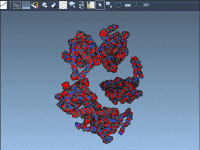
When analyzing or designing protein structures, molecular modelers often encounter the challenge of working with incomplete biological assemblies. PDB files offer a rich source of structural data, but this data can be encoded in multiple ways — complicating the reconstruction…
Many molecular modelers still rely on laborious copy-pasting or screen capturing to save snapshots of their work for later analysis or sharing. While this may work for visuals, it often results in losing important structural or simulation data along the…
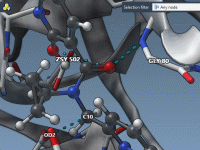
When building molecular models, clarity is everything. Whether you’re preparing figures for a publication or trying to better understand your system, labels play a crucial role in making data stand out. But what happens when your labels overlap with atoms,…
Controlling the flow of a molecular presentation can be surprisingly challenging. Whether you are preparing an animation for a lecture, building an online tutorial, or presenting a research project, timing and clarity matter. One common frustration molecular modelers face is…
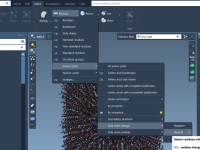
Working with GROMACS simulations often requires a deeper level of system customization—especially when analyzing specific molecular interactions or controlling particular subsets. If you’re looking to pull a specific group of atoms or analyze a charged residue cluster, you probably need…
When working on complex molecular systems, sometimes you need to refine only a specific part of a molecule—perhaps a side chain in a protein or a distorted fragment—without altering the rest of the structure. Fully minimizing the entire system can…
Any molecular modeler who has ever wrestled with the maze of file formats knows the pain: one collaborator sends you a .pdb, another uses .gro, and a public database exports your target structure in a format you’ve never even seen…
When crafting molecular animations, a common challenge faced by modelers is how to emphasize key events—such as the binding of a ligand or the disappearance of a residue—without overwhelming the viewer with continuous motion. Sometimes, less is more. The Flash…
When working on complex molecular modeling projects, it’s not uncommon to have dozens of associated files: scripts, simulation results, plots, PDFs, datasets and perhaps even documentation. These extra files can quickly become difficult to manage, especially when transferring projects between…
One of the common challenges in molecular modeling is presenting protein-ligand interactions in a way that’s both visually engaging and scientifically meaningful. You might find yourself struggling to explain how a ligand fits into a binding site — or more…