



Two protein structures can show different conformations, but the gap between them is often the hard part. A modeler may need intermediate structures to inspect a motion, define a reaction coordinate, or prepare a starting path for simulation. Simply placing the endpoints side by side does not explain how one conformation might transition into the other.
SAMSON’s ARAP Interpolator generates a sequence of intermediate conformations between a start and a goal structure. The path is useful for exploring structural change and preparing further analysis; it should not be mistaken for proof that the protein follows that exact physical route. Here is a practical workflow, including the preparation choices that help avoid common failures.
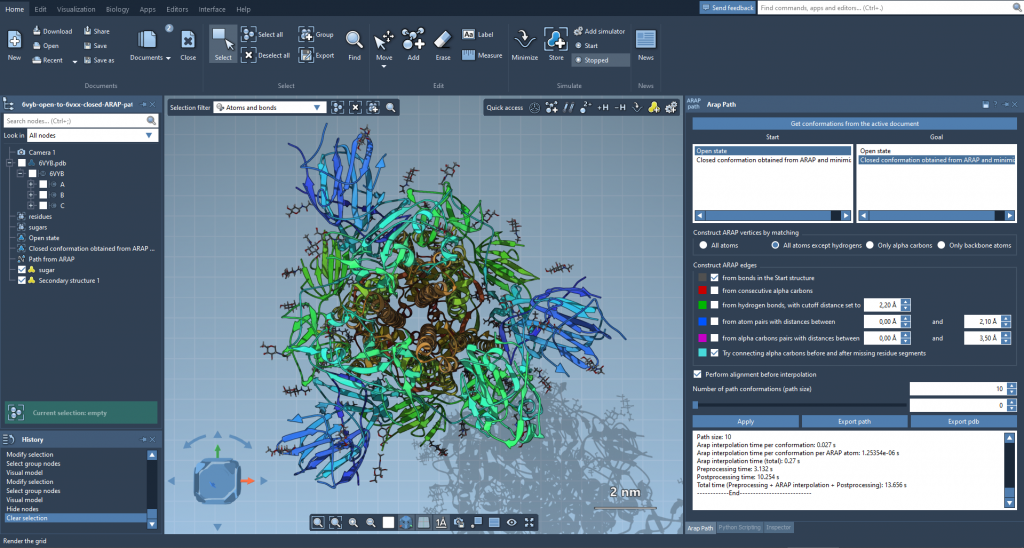
Start with comparable structures
The example uses two conformations of diphtheria toxin: PDB entries 1DDT and 1MDT. In SAMSON, load both from Home > Fetch, then work with chain A in each. The tutorial removes chain B from 1MDT so the comparison is between the intended chains.
Next, run Home > Prepare on both structures. This removes alternate locations, water, ligands, and ions. Preparation is more than housekeeping: disconnected extra components can prevent the interpolation from running. If the app reports that the structure does not make one connected component, check for these remaining components and prepare the structures again.
Create a conformation for each cleaned structure using Edit > Conformation. Give them clear names such as 1DDT A and 1MDT A. These become the start and goal states, so descriptive names make it easier to verify that the endpoints are assigned correctly.
Choose what should be matched
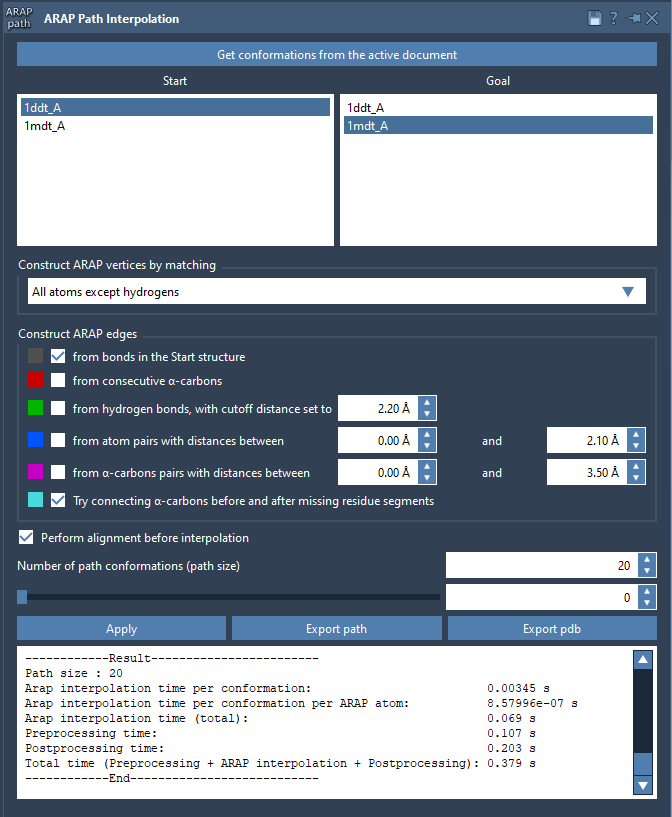
Open Home > Apps > Biology > ARAP Path Interpolation, retrieve the conformations from the active document, and select 1DDT A as Start and 1MDT A as Goal.
For matching atoms, the example uses All except hydrogens. This matches non-hydrogen atoms between the conformations and uses the matched start atoms as ARAP vertices. Other choices are available: all atoms, only alpha-carbons, or only backbone atoms. The right choice depends on what you want the path to represent; for example, restricting matching to alpha-carbons focuses the correspondence on the protein backbone trace rather than every atom.
Build connectivity with missing residues in mind
For ARAP edges, select from bonds in the Start structure and Try connecting alpha-carbons before and after missing residue segments. The first uses covalent bonds in the start structure. The second adds connections across gaps where residues are missing. That option matters because missing segments can otherwise leave the structural representation discontinuous.
Edge construction choices define the local connections used by the interpolation. Other available methods include consecutive alpha-carbons, hydrogen bonds below a cutoff distance, and atom pairs within a distance range. When multiple methods are selected, edges are added in the displayed top-to-bottom order. Start with choices that reflect the structure you have, rather than enabling every option by default.
Align, compute, and inspect
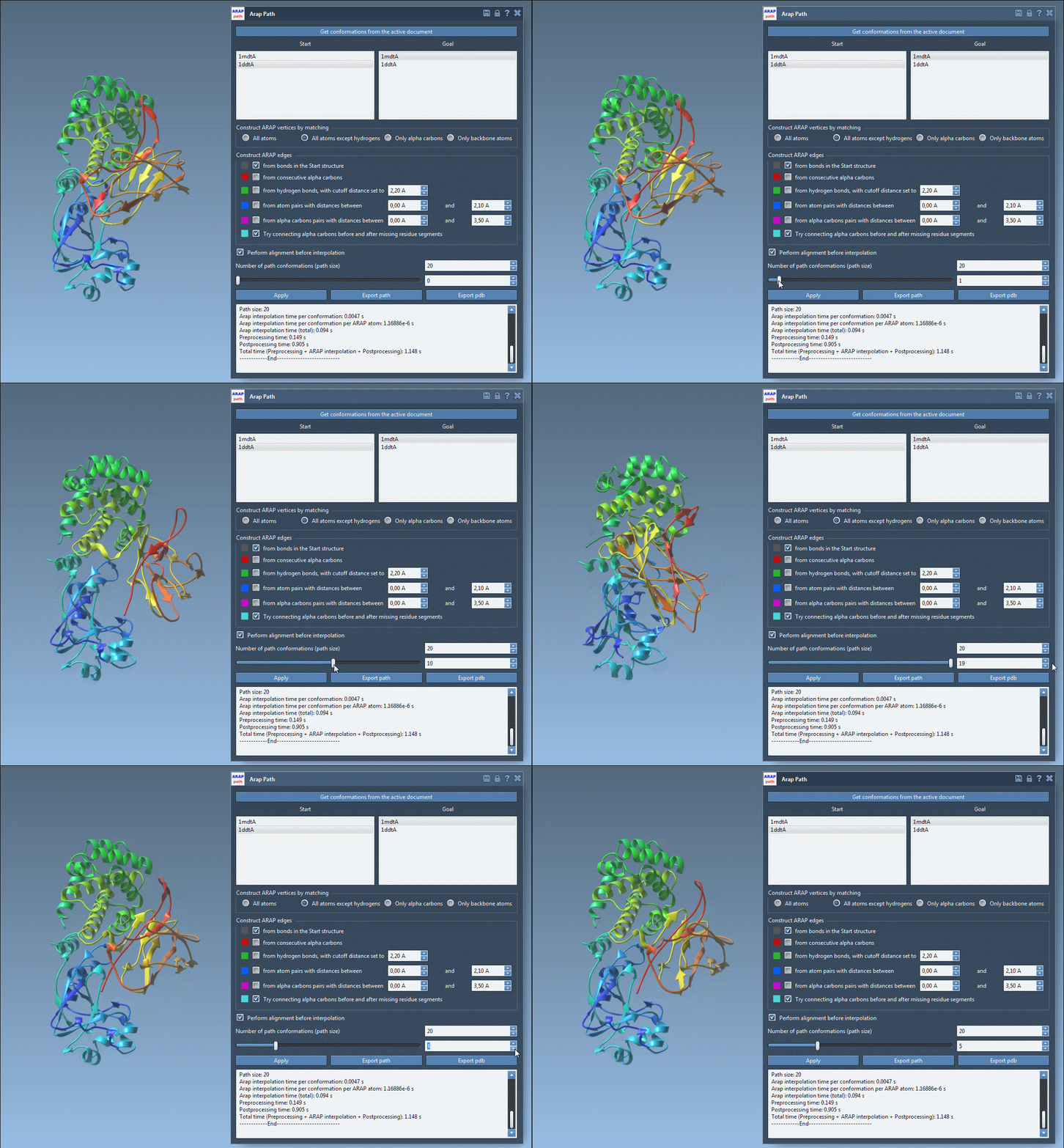
Enable Perform alignment before interpolation so the start conformation is aligned with the goal before the path is computed. Set Number of path conformations to 20 for a sequence of 20 conformations, including the start and goal, then click Run.
When the calculation finishes, review the computation information and use the app’s slider to move through the intermediate conformations. Inspecting the sequence is a useful sanity check: it lets you see how the model changes between endpoints rather than relying only on the final output. The generated ARAP edges can also be shown or hidden in the Document view; their colors indicate the construction types used.
Keep the path useful after interpolation
Use Export path to save a path object in the current SAMSON document, or Export PDB to write the whole path and individual conformations as sequential PDB files. The resulting path can support visualization and further work, such as setting up umbrella sampling with the GROMACS Wizard umbrella-sampling workflow, or refining a transition path with P-NEB.
The key is to treat interpolation as a practical bridge between endpoint structures: prepare clean, comparable inputs, choose sensible atom matching and connectivity, then inspect and export the result for the next stage of analysis.
For the full walkthrough and additional settings, read the original ARAP Interpolation tutorial.
Note: SAMSON and all SAMSON Extensions are free for non-commercial use. Get SAMSON.