



Refining protein structures can be tricky business for molecular modelers, especially when it comes to ensuring residues are in energetically favorable conformations. This is where the Interactive Ramachandran Plot Extension in SAMSON becomes an invaluable resource. This tool not only helps you visualize φ (phi) and ψ (psi) backbone angles but also offers a hands-on approach to refining conformations interactively. Let’s dive into how this works and why it may solve a major challenge in structure refinement.
Why Ramachandran Plots Are Vital
A Ramachandran Plot maps out the energetically allowed regions for a protein’s backbone dihedral angles. These plots give insight into which conformations are sterically or energetically unfavorable, helping identify residues that need adjustment. For example, white areas on the plot indicate strained positions, while yellow areas represent safe, favorable zones.
With the Interactive Ramachandran Plot tool, correcting these strained residues becomes intuitive and efficient—it updates structures in real time as you work.
Interactive Editing Options: Streamline Your Refinements
The extension provides two powerful ways to edit residue dihedral angles interactively:
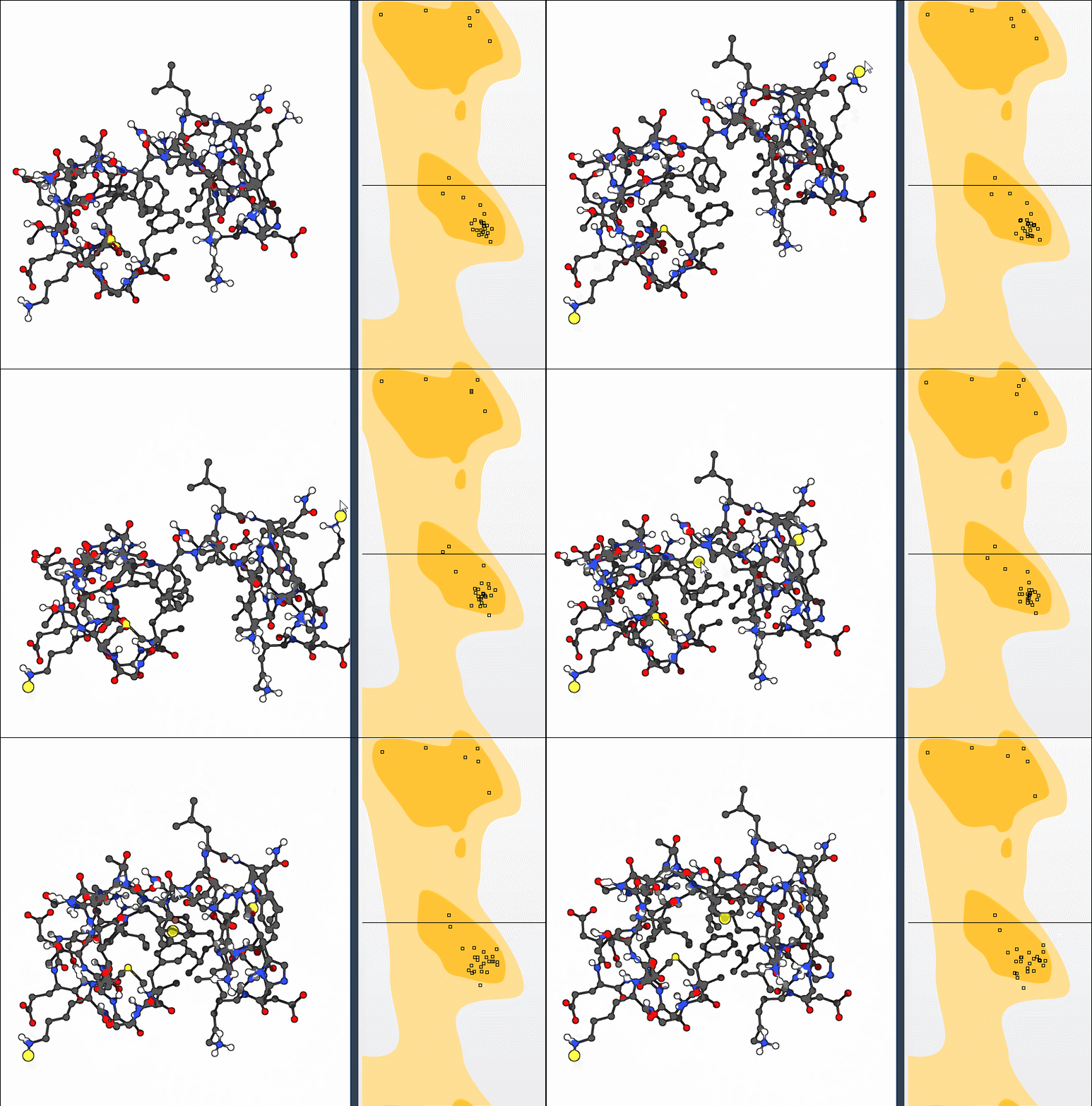
Option 1: Dragging Points Directly in the Plot
- Simply click and drag any point in the Ramachandran Plot to adjust the corresponding backbone dihedral angles instantly.
- The protein structure in the 3D viewport updates live, letting you immediately assess the changes.
- Not happy with a modification? Undo with Ctrl/Cmd + Z for quick corrections.
This drag-and-drop capability makes it incredibly easy to make sure protein residues land in energetically favorable regions.
Option 2: Using the Twister Editor for 3D Adjustments
The Twister Editor provides a 3D manipulation interface:
- Activate the Twister editor from the left-hand menu in the viewport.
- Twist the dihedral angles visually in 3D space—watch the corresponding point on the Ramachandran Plot shift dynamically.
This method is not only interactive but also visually intuitive, giving you more control over how the overall protein shape evolves.
When Should You Use These Tools?
- Detect and correct strained residues before running molecular simulations.
- Improve structural models generated via homology modeling.
- Analyze and perfect conformational flexibility around active or binding sites in your protein.
The real-time feedback from both the plot and the 3D structure ensures a smooth refinement process, particularly helping you to optimize proteins for modeling, simulation, or even experimental studies.
Conclusion
By integrating interactive feedback directly into your modeling workflow, the Interactive Ramachandran Plot tool in SAMSON brings a highly targeted approach to backbone conformation editing. Spend less time troubleshooting strained regions and more time getting your molecular models simulation-ready!
To learn more about how to use this feature, visit the original documentation page: https://documentation.samson-connect.net/tutorials/ramachandran/ramachandran-plot/.
SAMSON and all SAMSON Extensions are free for non-commercial use. You can download SAMSON at https://www.samson-connect.net.