



Molecular modeling often involves refining structures or exploring interactions. Accurately representing bond orders is a key component of understanding molecular behavior, but it can be a tricky and time-consuming task. Fortunately, SAMSON’s UMA Force Field interaction model includes multiple bond update modes to simplify this process. Here’s how you can effectively use this feature to maximize your workflow.
What Are Bond Update Modes?
The Bond Update Mode in UMA allows you to define how covalent bonds are updated during simulations. Depending on the situation, you may choose to recompute bonds dynamically or rely on a fixed bond graph. The feature provides flexibility and enables deeper insight into molecular mechanics as you refine or explore your system.
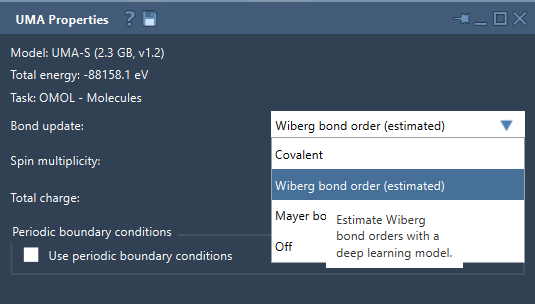
UMA offers the following bond update modes:
- Covalent: Automatically recomputes covalent bonds from the current molecular structure, ensuring real-time updates when atomic positions change.
- Wiberg bond order (estimated): Displays estimates based on Wiberg bond orders computed using a deep-learning model. Great for visualization and quick insights.
- Mayer bond order (estimated): Visualizes Mayer bond orders, also computed using a deep-learning model, for more analytical exploration.
- Off: Keeps the predefined bond graph unchanged throughout the simulation. Ideal when you want to operate on a fixed structure.
When to Use Each Mode?
Each bond update mode serves specific purposes:
- Use Covalent mode in scenarios where bond rearrangements or new connections might naturally emerge, such as during molecular dynamics or stress testing.
- The Wiberg bond order and Mayer bond order modes are perfect for interactive explorations where you want clarity in bond strengths or bond assessments. Note that these are estimations and should be confirmed if critical conclusions depend on them.
- Set the mode to Off if you need to preserve a specific predefined structure, even when atomic positions change. This is useful for tasks like analyzing fixed geometries or comparing states.
Useful Tips
Note
While the deep-learning-based Wiberg and Mayer modes provide quick insights, they are estimations. Always use a high-accuracy reference method before making crucial decisions based on these visualizations.
The flexibility of UMA’s bond update modes ensures you can adapt the settings to match your goals. Whether you are exploring new systems or conducting focused refinements, selecting the right mode streamlines the process.
Conclusion
The UMA bond update modes bring versatility to molecular modeling, helping modelers efficiently explore and refine structures while maintaining control over bond representations. Dive into SAMSON’s UMA Force Field interaction model to simplify your workflow, enhance your analyses, and save valuable time.
To learn more about the UMA Force Field and its features, visit the original documentation page.
SAMSON and all SAMSON Extensions are free for non-commercial use. Get it now at www.samson-connect.net.