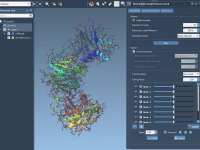
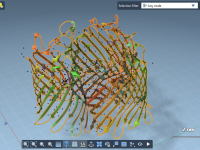
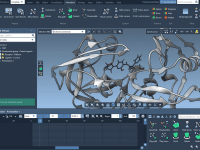
A protein structure is a snapshot, but a binding site may open only as the molecule moves. That creates a familiar problem for molecular modelers: the pocket is difficult to assess from one conformation, and it is not obvious which…
A familiar frustration in molecular modeling: you know what you want to do, but the tool currently responding to your mouse or keyboard is not the one you expected. A click that should select something may instead move around the…
A common source of confusion in molecular modeling is that the same nanosystem can have several different kinds of models associated with it. A protein may look correct on screen, yet that does not tell you which data define its…
Exploring a promising molecule often means asking a deceptively simple question: what happens if I change one position at a time? Making those variants by hand can become repetitive, and it is easy to lose track of which modification produced…
A molecular scene can contain exactly the right structures and still be difficult to follow. When everything is visible at once, viewers may not know where to look—or which part of the model is being introduced. A gradual reveal can…
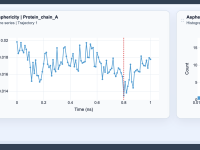
A molecular group can change its overall shape without becoming noticeably larger or smaller. That makes radius of gyration useful but sometimes insufficient: a single size measure may not reveal whether the group is becoming less spherical. Asphericity helps address…
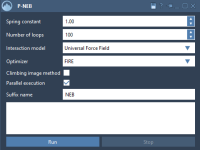
You have two plausible molecular states and a sequence of structures connecting them. But the in-between poses may be unevenly spaced or physically implausible. That is a common modeling bottleneck: generating a candidate route is not the same as refining…
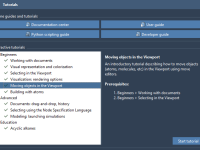
A familiar challenge in molecular modeling is not simply finding instructions—it is turning them into a workflow you can repeat. Reading a guide while working in the application can leave you switching attention between the page and the task. Interactive…
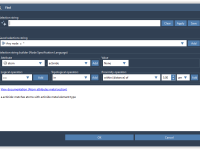
A molecular structure can contain thousands of atoms, while a modeling task may concern only a small subset: aromatic carbons, backbone atoms, water oxygens, or atoms in a particular region. Picking atoms one by one is slow and hard to…
You set a distance cutoff to inspect atoms near a residue, and SAMSON highlights far more than expected. The culprit may not be the distance: NSL can match different kinds of nodes in a molecular hierarchy. A document or group…