Bringing Depth to Molecular Models with Ambient Occlusion

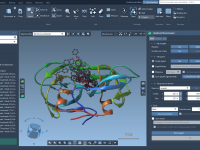
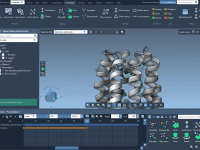
One of the most common challenges molecular modelers face is making molecular structures easy to interpret visually. When complex molecular systems are densely packed or intricately folded, it’s often hard to distinguish between overlapping parts or to perceive depth clearly.…

Filtering Molecular Files by Name and Selection in SAMSON

Molecular modelers often work with numerous structural files during their design workflows: input files from collaborators, output files from simulations, experimental datasets, and more. Sifting through these to identify which ones are important, modified, or selected for further analysis is…

How to Customize Atom Types and Bond Orders in UFF Simulations

Molecular modelers often rely on automatic perception tools to assign atom types and bond orders, which keeps simulations quick and intuitive. However, these automated systems may not always capture specific bonding environments or unusual structures, leading to inaccuracies in energy…

Quickly Filter Visible Notes in Complex Molecular Models

When working with complex molecular models, especially those involving large assemblies or systems with extensive annotations, being able to quickly identify and isolate visible notes can greatly improve efficiency and clarity. Notes might be used to store hypotheses, instructions, or…

Simplifying PMF Analysis with WHAM in GROMACS Wizard

Modeling molecular systems often involves calculating the Potential of Mean Force (PMF) along a reaction coordinate. This can be essential for understanding binding affinities, reaction mechanisms, and free energy landscapes. However, performing a PMF analysis—especially assembling and processing multiple simulation…