



For molecular modelers, tracking the shape evolution of molecules along a path or trajectory is crucial. However, relying solely on metrics like the radius of gyration often feels too coarse to capture finer shape changes. This is where the Asphericity analysis in SAMSON’s Path Analyzer tool shines, offering a clearer and more nuanced perspective on molecular shape anisotropy.
What is Asphericity?
Asphericity quantifies how far a molecule or a selected molecular group deviates from a perfect spherical shape along a defined path or trajectory. It provides a compact yet insightful way to monitor shape anisotropy, addressing the limitations of single-distance metrics. Instead of just measuring size changes, asphericity allows users to observe how shapes stretch, compress, or deviate from spherical symmetry over time or across structural conformations.
This is particularly helpful in identifying subtle structural changes that might otherwise go unnoticed. Whether you’re modeling protein folding, drug binding processes, or material deformations, asphericity can provide critical insight.
Adding an Asphericity Plot in SAMSON
Integrating an asphericity plot into your analysis in SAMSON is intuitive and straightforward. Here’s a step-by-step guide:
- Launch SAMSON’s Path Analyzer tool.
- From the “Observable” menu, select Asphericity.
- Specify the Path you want to analyze.
- Define the molecular Group of interest.
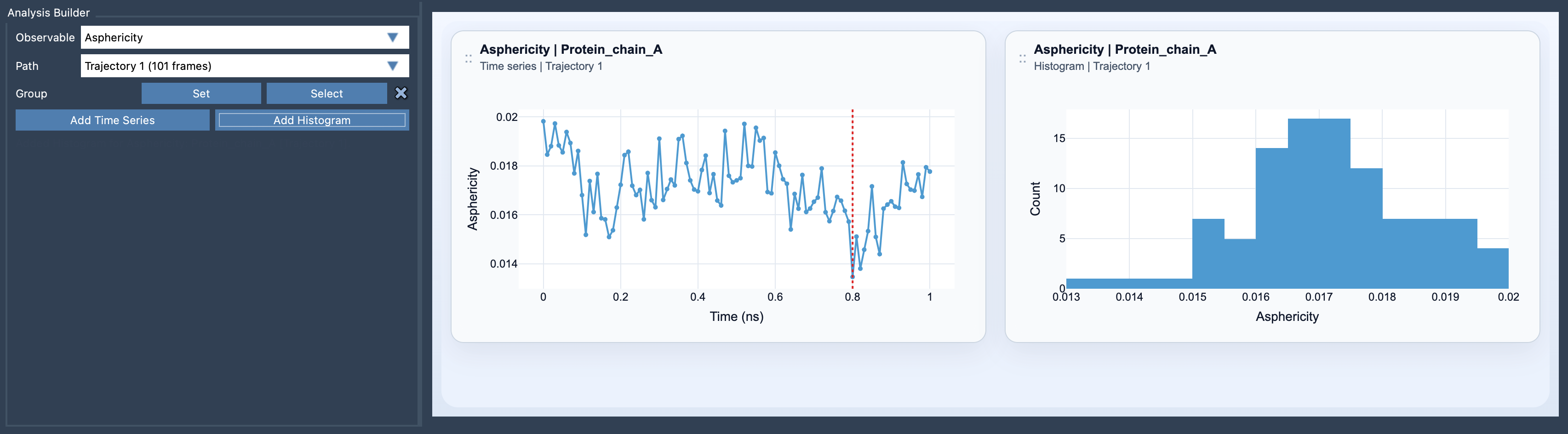
- Generate your visualization by selecting either Add Time Series to observe evolution along the path or Add Histogram to study sampled value distributions.
Choosing the Right View
Once you’ve set up your asphericity analysis, the Path Analyzer offers two key viewing options:
- Time series: This view allows you to trace molecular shape changes over time or along the trajectory.
- Histogram: Use this view to assess the distribution and range of sampled asphericity values, helping you determine the scale and consistency of structure shifts.
Why Pair Asphericity with Other Metrics?
While asphericity adds a valuable layer of insight, pairing it with complementary shape descriptors can deliver an even fuller picture. For instance, combining asphericity with radius of gyration provides a better understanding of size and shape, while coupling with the shape parameter further enhances your ability to track global structural changes.
Final Thoughts
If understanding molecular geometry is part of your workflow, asphericity analysis in SAMSON could be an ideal lens for your studies. Its ability to measure deviations from spherical shapes along trajectories or paths makes it an invaluable tool for anyone working on dynamic systems and structural modeling.
Ready to explore asphericity analysis yourself? Check out the detailed documentation here: documentation.samson-connect.net/users/latest/references/path-analyzer/asphericity/.
SAMSON and all SAMSON Extensions are free for non-commercial use. You can get SAMSON at www.samson-connect.net.