



One of the challenges faced by molecular modelers is accurately visualizing and understanding the motion of complex biomolecules, such as proteins, between their conformational states. For example, studying the spike protein of SARS-CoV-2—a key player in virus-host recognition—can reveal critical insights into mechanisms of infection and potential therapeutic targets. SAMSON provides an efficient and user-friendly way to generate transition paths between these states using the ARAP Interpolation Path module.
What is ARAP Interpolation Path?
ARAP, or “As-Rigid-As-Possible” Interpolation Path, is a computational module in SAMSON designed to interpolate structural transitions between well-defined initial and final states of a protein. For instance, if you have the open and closed conformations of a spike protein, ARAP can quickly and effectively generate a path that bridges these states. This is particularly helpful in understanding how a molecule transitions from one state to another, which could be critical for drug design and other applications.
Using ARAP for Protein Conformations
To compute the SARS-CoV-2 spike’s transition path from its closed to its open state:
- Prepare your data: Ensure you have both the closed and open structures (e.g., available in PDB format). For this example, the SAMSON tutorial uses two structures: PDB 6VXX (closed) and PDB 6VYB (open).
- Handle discrepancies: If your start and end structures differ in residues, preprocessing is needed. For the spike, bond orders in sugars were adjusted and hydrogens were added to minimize discrepancies.
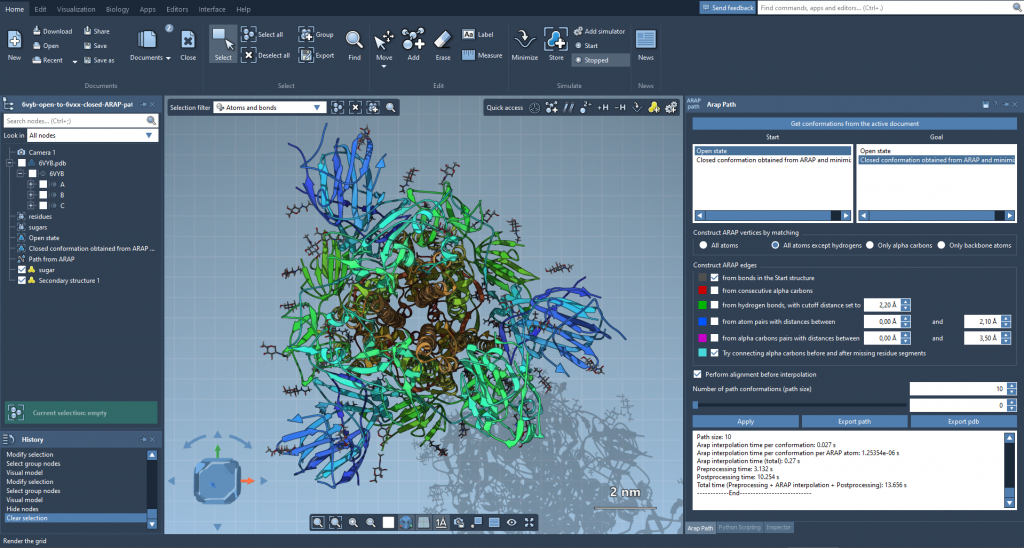
- Run the ARAP module: With SAMSON, set the open conformation as the starting state and the closed conformation as the goal. The ARAP module generates an interpolated path within seconds, even on a standard laptop.
In this process, ARAP generates smooth transitions by assuming proteins retain rigid regions. This results in reliable and biologically plausible paths, which can then be refined using additional modules such as P-NEB.
Interactive Visualization
SAMSON allows you to visualize the resulting trajectory in an interactive 3D environment. For the SARS-CoV-2 spike, you can explore how each region of the protein progresses along the path. Below is an image captured from the computed pathway:
Why ARAP Matters
The ARAP module is highly valuable for computational biologists and molecular modelers. It simplifies the process of visualizing protein dynamics and makes it accessible for broader research applications, such as:
- Analyzing structural transitions of proteins like the SARS-CoV-2 spike.
- Generating hypotheses for drug targeting and antibody design.
- Providing trajectory files for further computational analysis or molecular dynamics simulations.
Try It for Your Protein System
If you are working on a protein system but lack a straightforward tool to generate transition paths, ARAP in SAMSON could be the solution you’ve been searching for. After generating a trajectory with ARAP, you can refine it with the P-NEB module for even greater accuracy. Learn more about this workflow and download the modules from SAMSON’s documentation page.
For additional details and a complete tutorial, visit the official documentation page.
Note: SAMSON and all SAMSON Extensions are free for non-commercial use. You can download SAMSON from SAMSON Connect.