



A common frustration in molecular modeling is that two structures describe the states you want to compare, but they are not identical starting materials. They may differ in residue count or structural details, making a direct transition-path calculation less straightforward. The SARS-CoV-2 spike offers a practical example: its closed and open structures, PDB 6VXX and 6VYB, can be used to explore the movement, but their residue counts differ.
The important lesson is that a path between structures is not automatically a verified account of how a protein moves in nature. It is a computed route between chosen endpoint conformations. Understanding how that route was prepared—and what it can and cannot tell you—helps make the result more useful.
Start with the biological question
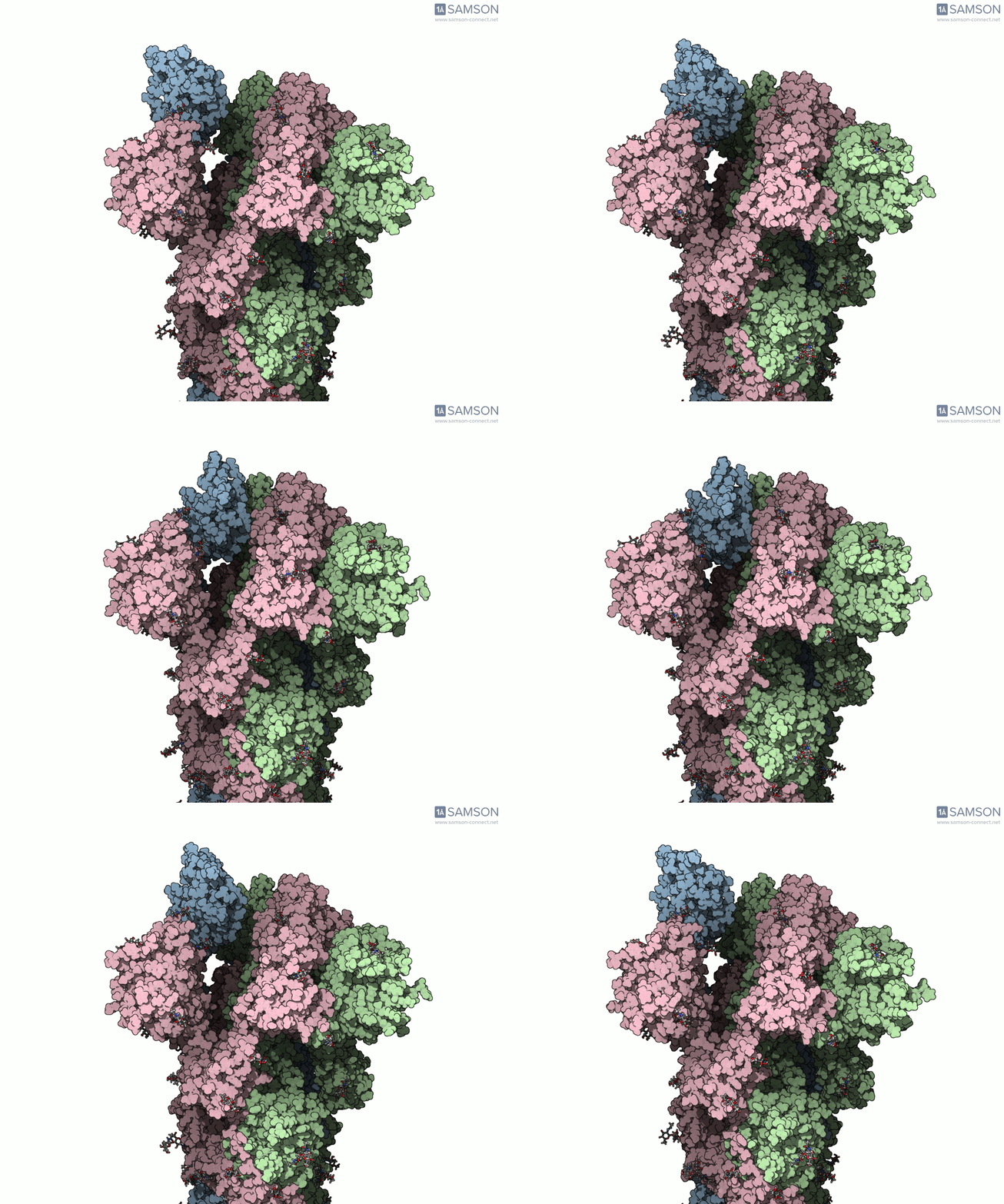
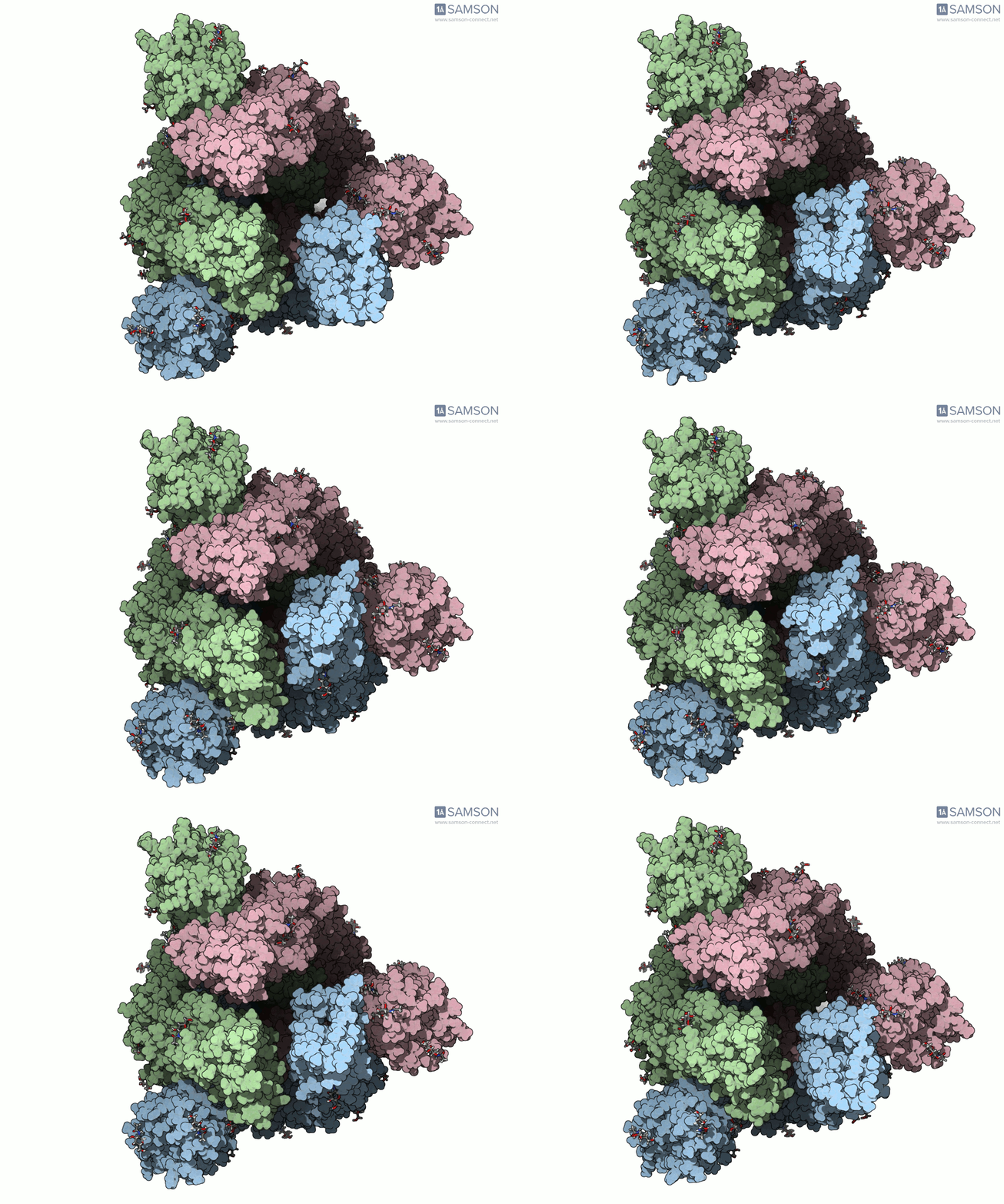
The spike is a three-protein assembly on the surface of SARS-CoV-2. Its receptor-binding domain can move from a down, or closed, arrangement toward an up, or open, arrangement that can bind the human receptor ACE2. This motion is useful to visualize because it connects a structural change to a biological function: access to the receptor-binding site.
The images below show the computed opening and closing motion from different viewpoints. Looking at more than one angle can help distinguish movement of the receptor-binding domain from changes in the overall view caused by rotation.
Why mismatched endpoints need care
A transition-path workflow depends on having structures that can be compared in a meaningful way. In this example, the open and closed spike structures have different numbers of residues. The workflow therefore does not simply treat them as interchangeable endpoints. It first prepares both structures, then uses an intermediate conformation to create a compatible target for refining the path.
In the documented SAMSON workflow, the preparation begins by correcting bond orders in sugars with a Python script and the Python scripting module. This matters because the next step adds hydrogens; bond representation is part of preparing the molecular structures for that operation. Hydrogens are then added to both structures, followed by minimization steps.
Next, the ARAP Interpolation Path module generates an initial path, using the open structure as the starting conformation and the closed structure as the goal. ARAP produces a path for the structure used as its starting conformation. Because the endpoint structures differ in residue count, the workflow takes a closed-like conformation from this path and minimizes it. That resulting conformation can then serve as a goal with a structure that matches the open-state path representation.
Finally, the P-NEB module is used to improve the path. In the documented example, the ARAP path generation took less than half a minute on a laptop, while the P-NEB step took about 15 minutes. Those are timings reported for this example, not guarantees for other systems or hardware.
Interpret the result as a model, not proof
The distinction between a computed path and an experimentally observed mechanism is essential. The provided trajectories are explicitly supplied as-is and have not been experimentally verified. They can illustrate a possible structural transition and may be useful as a starting point for further calculations, but may need post-processing or additional validation before being used for scientific conclusions.
For exploration, the trajectory is available as separate PDB files, a single PDB trajectory, or a SAMSON file. The SAMSON file includes the spike structure, open and closed conformations, and paths from ARAP and P-NEB. In SAMSON, the conformations can be restored by double-clicking, and the path can be animated by double-clicking its entry.
This workflow is useful beyond this particular protein because it makes the preparation decisions visible: check whether the endpoints are structurally compatible, prepare chemical representations before adding hydrogens, inspect the initial path, and treat refinement as a computational step—not experimental validation.
Explore the original documentation page to learn more.
Note: SAMSON and all SAMSON Extensions are free for non-commercial use. Get SAMSON.