



Did you know that understanding symmetry in biological assemblies can significantly enhance your molecular modeling workflows? For molecular modelers working on protein complexes, viral capsids, or other large assemblies, symmetry detection is more than just a cool visualization tool—it’s an essential step to optimize time and resources and even guide designs. In this blog, we’ll explore why symmetry detection is so valuable and how to make the most of it using SAMSON’s Symmetry Detection extension.
Streamlining Computational Workflows
Simulating molecular systems is computationally expensive, especially when dealing with large, intricate biological assemblies. Symmetry detection helps reduce costs by allowing you to model just the unique asymmetric unit rather than entire complexes. For example, a protein complex with dihedral symmetry can often be reduced significantly in size, leaving you with the essential, non-redundant parts of the molecule to simulate. That’s a considerable time-saver.
Validate and Guide Molecular Designs
Detecting symmetry can validate your experimental structures by confirming expected symmetry elements. In cases where the symmetry differs from what’s anticipated, it may suggest structural artifacts—or reveal unexpected complexity! Moreover, symmetry detection is invaluable for guiding molecular design. For instance, designing symmetric nanomaterials or targeting mutagenesis within functional interfaces becomes much easier when symmetry axes are clearly defined and visualized.
What Types of Symmetry Can Be Detected?
The Symmetry Detection extension supports various symmetry types commonly found in biological systems:
- Cyclic: Symmetries such as C2, C3, and others of any order.
- Dihedral: More complex symmetries like D2, D3, and higher-order dihedral groups.
- Cubic: Tetrahedral, octahedral, and icosahedral symmetries typical of large assemblies like viral capsids.
The tool may even detect multiple symmetry groups simultaneously, particularly in large assemblies where overlapping symmetry patterns are possible.
Use Case: Icosahedral Symmetry in 3NQ4
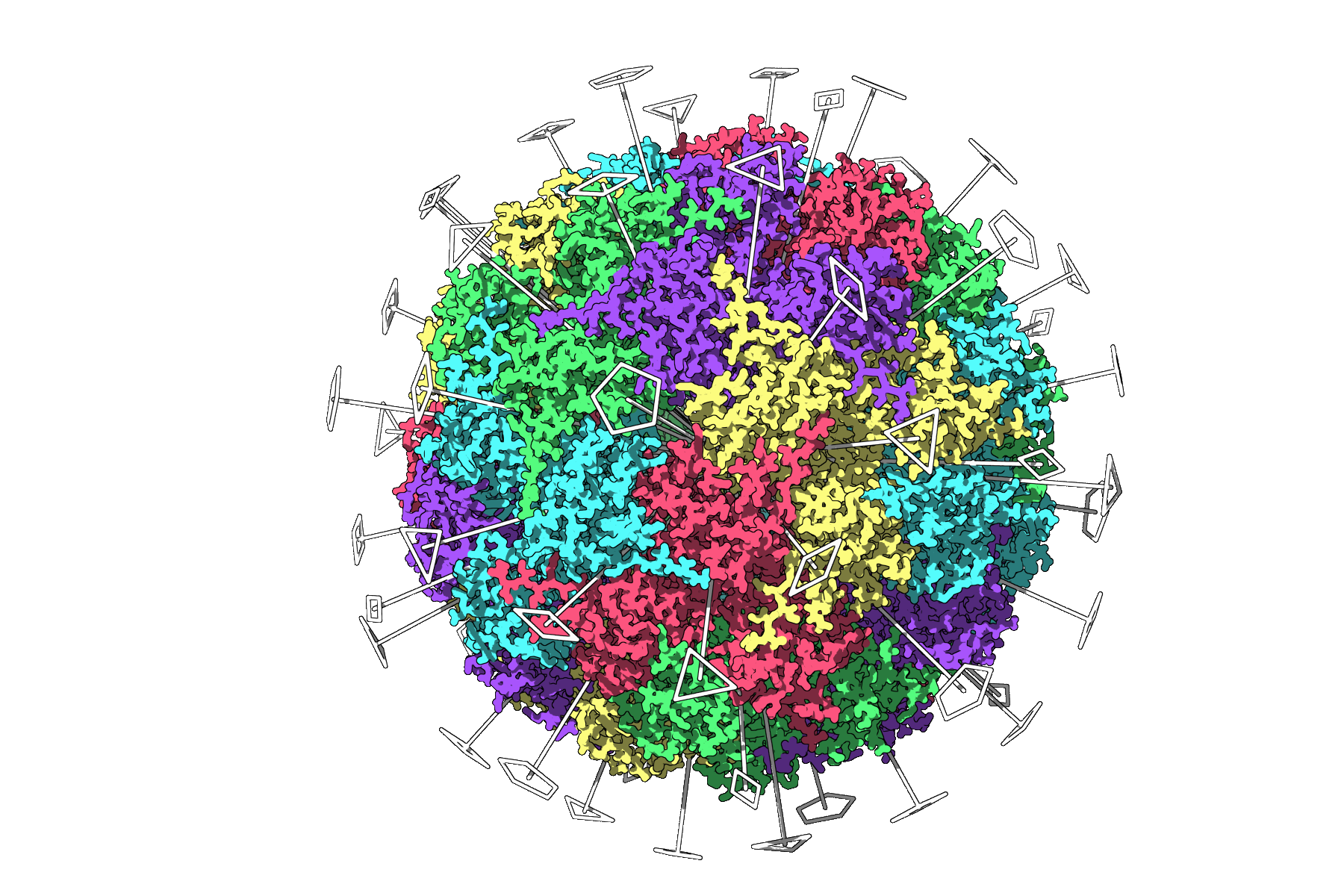
One standout example is the icosahedral symmetry of the 3NQ4 viral capsid. The Symmetry Detection extension identifies all 2-fold, 3-fold, and 5-fold axes, displaying them for you to explore and select a unique asymmetric unit. Imagine the time—and computational resources—you save by simulating only a fraction of the full capsid while maintaining scientific rigor!
Making the Most of Detected Symmetry
Once detected, symmetry groups can be analyzed in detail using features like:
- Exploring individual symmetry axes and their associated RMSD values (root mean square deviation).
- Aligning your viewport to examine symmetry axes directly.
- Specifying expected symmetry groups manually if you already have a hypothesis (e.g., detecting D3 symmetry in the 1B4B system).
These interactions enable a deeper understanding of your system, whether your goal is validation, visualization, or simulation preparation.
Tips for Better Visualization
Providing context to molecular structures is critical when preparing figures or comparing symmetry elements:
- Combine symmetry axes with ribbon representations or surface models for clear visualization.
- Color individual chains to emphasize the repeating units within a symmetry group.
- Capture detailed images for publications or presentations using SAMSON’s viewport snapshot tool.
Start Detecting Symmetries Today
The Symmetry Detection extension in SAMSON offers a range of features to help streamline workflows, explore assemblies in greater detail, and make symmetry-aware design decisions. To get started with step-by-step instructions or explore advanced use cases, visit the original documentation page at this link.
SAMSON and all SAMSON Extensions are free for non-commercial use. Download SAMSON at https://www.samson-connect.net.