



A molecular transition path can look reasonable at first glance and still contain awkward intermediate structures: atoms may take an indirect route, or neighboring frames may be unevenly spaced. The hard part is often not finding a sequence of structures, but refining a candidate sequence so it better reflects the system’s interactions.
The Parallel Nudged Elastic Band (P-NEB) app in SAMSON is designed for that refinement step. It optimizes the intermediate images along an existing path, using the Nudged Elastic Band method to balance the system’s forces with spring forces between neighboring states. It is useful when you already have a rough path or a set of conformations. It is not a path generator: if you only have starting and ending structures, first create intermediate conformations using a suitable method, such as interpolation or a path-finding extension.
Start with a candidate path
For example, you might have two relaxed states of a ligand-bound system and a proposed route between them. The endpoints can be local energy minima obtained with a minimizer such as FIRE. A sequence of intermediate conformations can be created with linear interpolation, or a path can come from an app such as Ligand Path Finder. P-NEB then gives you a way to improve that initial route rather than treating the initial guess as the final answer.
SAMSON represents a path as a trajectory for a selected group of atoms. A conformation stores positions for a selected group of atoms. P-NEB accepts either a path or a set of conformations, but for the same system and number of steps, the documentation recommends using a path because optimizing a set of conformations takes longer. If you have conformations already, you can select them in the Document view and use Conformation > Create path from conformations to combine them.
Run P-NEB on a path
- Add the P-NEB extension and the FIRE state updater, and load a document containing the candidate path.
- Open P-NEB from Home > Apps > All > P-NEB, or find it with the Find everything… search box.
- Use the tutorial’s example settings as a starting point: spring constant
1.00,100loops, Universal Force Field, and FIRE as the optimizer. Enable parallel execution if you want the app to run one thread per conformation. - Select the path in the Document view and click Run. When the Universal Force Field setup asks whether to use existing bonds, choose to use them and confirm.
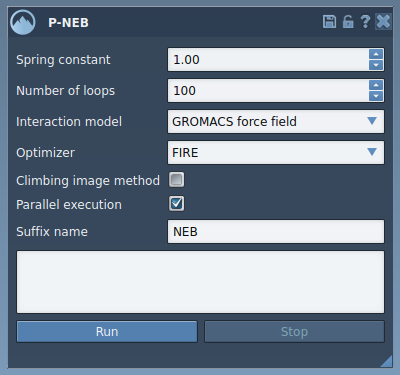
The climbing image option is available for locating a saddle point. In the tutorial workflow, it is left unchecked for the first run; you can try a subsequent run with it enabled. This keeps the basic path-refinement step distinct from the optional climbing-image strategy.
Check what the calculation produced
Watch the status bar for computation progress. When optimization finishes, a new path appears in the Document view, and the P-NEB interface provides a computation summary. Select the resulting path and inspect it in SAMSON; double-clicking a path starts or stops its animation, which can make it easier to review how the selected atoms move along the trajectory.

Reviewing the result matters: optimization refines a supplied candidate, but it does not remove the need to assess whether the path is appropriate for your scientific question. Keep the original path available for comparison, and inspect the intermediate structures rather than relying only on the fact that a run completed.
If you are starting from conformations rather than a path, select the set in the Document view and click Run. The same force-field prompt applies, and the resulting optimized conformations appear in the document. For repeated work on the same system, however, converting the set to a path first is the more efficient workflow described in the tutorial.
Once you have inspected the optimized conformations, you can export the path or continue with a simulation or free-energy workflow. For the complete instructions and related tutorials, learn more in the P-NEB documentation.
Note: SAMSON and all SAMSON Extensions are free for non-commercial use. Get SAMSON.