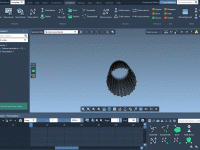
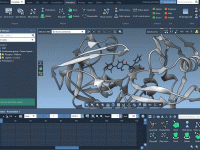
It’s one of the most common struggles when creating a molecular animation: how to smoothly zoom into a specific part of a complex molecular system. Whether you’re preparing a presentation, an educational video, or just trying to understand your structure…
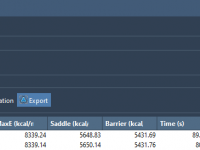
When studying protein conformational changes, it’s not enough to know the start and end states. Understanding how a protein moves between these states—through what pathways and at what energetic cost—is key for applications like drug design, enzyme engineering, or understanding…
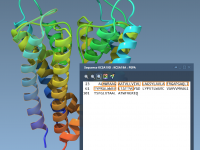
For molecular modelers working with large biomolecular systems like proteins and nucleic acids, jumping between 3D structures and their primary sequences can often feel disjointed. Whether you’re selecting active sites, isolating chains, or analyzing mutations, a tool that bridges the…
When working with complex molecular systems, it is often necessary to focus on conformations that meet specific structural criteria. One frequently encountered need is identifying conformations with a large number of atoms—common in macromolecular systems or aggregated structures. If you’re…
For molecular modelers, working between different representations of a biomolecule—3D structures, sequence data, and document-based views—can often lead to frustrating disconnects. You spot something interesting in a protein’s sequence, but selecting it in the sequence doesn’t highlight it in the…
One of the more challenging tasks in molecular modeling is understanding how a ligand navigates its way out of a protein binding pocket. Whether you’re studying drug binding kinetics, escape routes, or trying to visualize molecular flexibility, it can be…
Color is more than visual flair in molecular modeling — it’s a vital tool for interpretation, annotation, and storytelling. Especially when handling large systems, molecular modelers often need to distinguish between specific chains, ligands, or molecular properties at a glance.…
One of the most common challenges in molecular modeling is effectively directing attention in a dynamic scene. Whether you’re showcasing ligand binding, conformational changes, or molecular assemblies, clarity is key. Many modelers default to using transparency to hide or reveal…
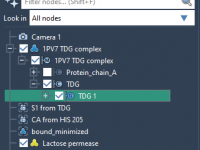
When working with molecular structures, modelers frequently face a common challenge: selecting specific groups of atoms based on complex spatial or chemical criteria. Scrolling through long atomic lists, manual picking, or relying on external scripts can be tedious and error-prone,…
When presenting complex molecular systems, timing can make all the difference. Whether you’re showcasing a structural transition, an interaction event, or an energy minimization step, there are critical moments that warrant an extra second—or five—for your audience to absorb what’s…