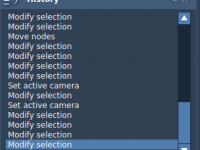
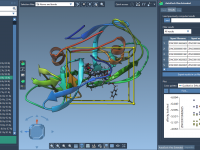
When working with molecular models, experimentation is essential — but mistakes are inevitable. Whether it’s an accidental deletion, a misalignment, or even just curiosity to explore alternate paths, having the ability to retrace your steps without losing progress is crucial.…
Creating analog libraries is a common part of early-stage molecular design or virtual screening workflows. But what happens once you have a list of 2D chemical analogs—how do you go from a SMILES representation to three-dimensional molecular models ready for…
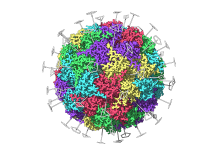
Running simulations on large protein assemblies can be computationally expensive. But what if you only had to simulate a fraction of it — without losing critical insights? This is exactly where symmetry detection makes a difference. Many biological macromolecular assemblies…
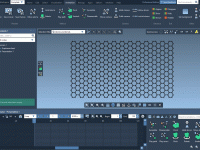
When setting up a coarse-grained (CG) molecular simulation, one of the most frequent stumbling blocks for modelers is improperly defined boundary conditions. A misconfigured periodic box can lead to unphysical interactions and ultimately unreliable results. In CG systems — particularly…
When molecular modelers perform virtual screening or docking of ligand libraries, one common challenge is managing and interpreting the output. The task doesn’t end with docking — in fact, that’s just the beginning. Making sense of hundreds (or thousands) of…
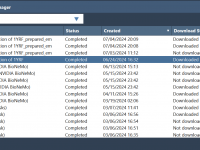
Running complex molecular simulations in the cloud can be a time-saver, but many molecular modelers find themselves juggling dozens of jobs without a good way to keep everything organized. Whether you’re launching protein folding simulations with AlphaFold, running molecular dynamics…
Molecular modelers and educators often face the challenge of drawing attention to specific regions of a molecule during presentations or animations. Whether you’re preparing a lecture, a publication figure, or an animation for collaboration, it’s sometimes essential to progressively hide…
Sharing and storing molecular models outside the design environment is an essential part of a molecular modeler’s daily work. Whether you’re preparing data for a publication, collaborating with colleagues, or setting up simulations in another tool, exporting your models in…
Working with large molecular systems often means searching through numerous molecules to identify the right structures for your simulations or analysis. A common task for molecular modelers is filtering molecules by the number of specific atoms they contain—for instance, selecting…
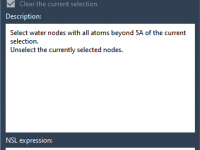
When preparing molecular systems for simulation, removing water molecules is a common step. However, not all waters are useless. Some are tightly bound or located in active sites and play critical roles in structure and function. Deleting all crystal waters…