Syncing Molecular Trajectories with ‘Play Path’ in SAMSON
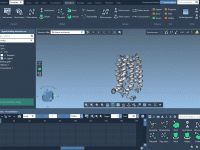
Visualizing molecular trajectories is essential for understanding complex behaviors such as conformational changes, docking events, or transitions between molecular states. But synchronizing multiple paths or smoothly animating a recorded trajectory can be challenging—especially when the number of frames doesn’t match…
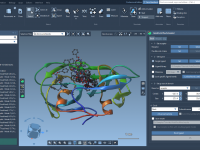
What Are SAMSON Apps and Why Should Molecular Modelers Care?

Integrating complex tools is often a roadblock for molecular modelers. Whether it’s accessing external software, running simulations, or visualizing structure-function relationships, the ecosystem can feel fragmented. You’re forced to juggle between environments — installing plugins, converting file formats, or writing…

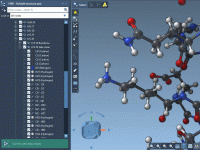
Navigating Complex Molecular Projects with Document View in SAMSON

When working on multi-layered molecular design projects, clarity and structure are essential. Whether you’re modeling a protein-ligand interaction or managing multiple systems in parallel, organizing your data hierarchy efficiently can save hours of repetitive work—and more importantly, reduce error. That’s…

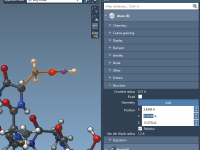
A Quick Way to Neutralize Your MD System Before Simulations

Anyone working with molecular dynamics knows that skipping proper charge neutralization of your system can cause serious artifacts during simulation. From incorrect electrostatics to instabilities during energy minimization, imbalanced systems can quietly sabotage your simulation before it even begins. Thankfully,…

Previewing and Creating Symmetry Mates in One Click

Many molecular modelers have faced the challenge of reconstructing complete protein assemblies from asymmetric crystallographic units. Knowing how subunits interact symmetrically is key for understanding biological function, designing protein-based materials, and setting up molecular simulations. But replicating these symmetric arrangements…

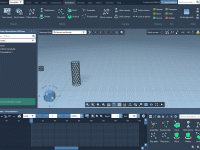
A Practical Guide to Moving Atoms Over Time in Molecular Animations

One of the recurring challenges in molecular modeling is conveying motion—especially when creating educational or presentation materials about dynamic systems. Whether you’re illustrating a conformational transition, animating a simulation step, or presenting a mechanical movement inside a nanosystem, static images…