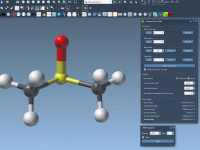
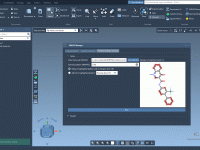
Synchronizing Trajectories: A Better Way to Play Molecular Paths in SAMSON
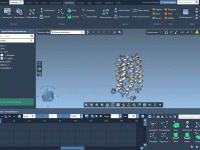
When working with molecular systems that involve flexible conformations, dynamics, or simulations, visualizing movements across trajectory frames can quickly become unwieldy. Molecular modelers often need to revisit and align transitions—whether from different simulations, conformational states, or interpolation paths—to better understand…
Freezing Atoms to Minimize Just Part of a Molecule

In molecular modeling, it’s not uncommon to need fine-grained control over how parts of a molecule are optimized. Whether you’re modeling a protein undergoing a point mutation, refining a flexible loop while keeping the rest of the structure in place,…

Easily Find Hidden and Visible Backbone Nodes in SAMSON

Molecular modelers working with complex structures often face a recurring challenge: navigating crowded scenes with many overlapping molecular elements. When certain parts of a structure are hidden or set to different visibility states, it’s easy to lose track of important…

Controlling Light Node Visibility in Molecular Scenes

In molecular modeling and visualization, lighting plays a key role in making scenes more comprehensible. Lights can make molecular structures clearer, emphasize important regions, and improve overall realism — but working with complex scenes can quickly become frustrating when you’re…