Visualizing the SARS-CoV-2 Spike in Motion

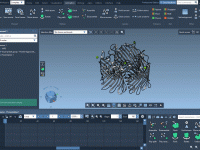
For molecular modelers tackling the intricacies of SARS-CoV-2, understanding the motion of the spike protein is essential. This dynamic protein plays a critical role in the virus’s ability to infect host cells, transitioning from a closed state to an open,…

Understanding and Using Active Editors in SAMSON

For molecular modelers, the ability to intuitively manipulate structures or create new models with user-friendly tools is key to productivity. SAMSON, the integrative molecular design platform, provides a unique approach to achieving this through its powerful editors. But did you…

Streamline Protein-Ligand Modeling with 2D Interaction Diagrams

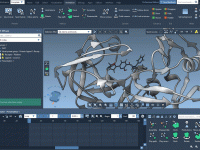
For researchers and molecular modelers working with protein-ligand interactions, visualizing and exploring molecular interactions effectively is essential yet often challenging. The SAMSON Interaction Designer offers a user-friendly way to bridge the gap between 3D and 2D molecular modeling, enabling researchers…

Mastering Transparency with the Appear Animation

When it comes to molecular modeling, conveying complex structural transitions or changes in a clear and captivating way is a frequent challenge. Have you ever struggled with highlighting specific parts of a molecular model while maintaining a professional, visual flow?…

Simplifying Bond Adjustments in Molecular Models with SAMSON

One of the key pain points for molecular modelers is adjusting bond orders effortlessly during the molecular design process. Whether you’re tweaking a molecule for a simulation or fine-tuning structures for downstream analysis, inaccurate bond assignments can hinder your workflow.…

Mastering Folder Attributes for Efficient Molecular Design

For molecular modelers working with complex structures and data, managing folders effectively can significantly streamline the design process. SAMSON, the integrative molecular design platform, provides a robust and intuitive system for working with folder attributes through its Node Specification Language…

Effortlessly Adding Custom Index Groups in GROMACS Wizard

If you’re working with molecular simulations using GROMACS, you’ve probably experienced moments where the default index groups aren’t enough for your specific needs. Custom index groups can be invaluable for analysis or simulation-specific parameters, such as defining pull coordinate groups.…

Simplify Topology Changes with IM-UFF in Molecular Modeling

One of the challenges in molecular modeling is managing smooth transitions during topology changes — like breaking or forming covalent bonds — without disrupting simulations. Introducing the Interactive Modeling Universal Force Field (IM-UFF), an extension of the Universal Force Field…