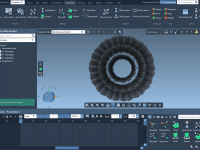
A static molecular structure can be difficult to explain. A small, controlled movement can help viewers inspect a group of particles and make an animation feel more intentional—but creating that motion by repositioning particles frame by frame can become a…
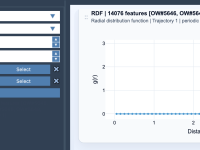
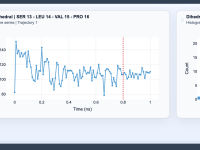
When two molecular groups appear close in a structure, it is tempting to treat one snapshot as the whole story. But a single distance may not tell you whether that arrangement is common, rare, or part of a broader pattern.…
Large molecular projects can become difficult to navigate for a simple reason: the structure you need is somewhere in the scene, but names alone don’t tell you whether it has the right size, composition, or organization. In SAMSON, the Node…
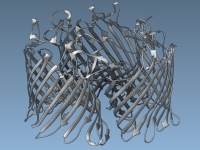
A molecular scene can contain all the right structural information and still be hard to read. Ribbons overlap, distant parts blend into the background, and it may be difficult to tell which object sits in front of another. The problem…
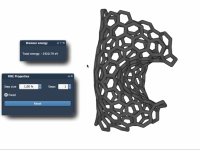
A molecular structure can look plausible on screen and still need some cleanup before you use it in a simulation. Small geometric irregularities may remain after building or editing a model, and manually adjusting atoms one by one is rarely…
A molecular structure can look almost unchanged while a side chain rotates, a backbone torsion shifts, or a larger part of the system twists. These motions can influence how a conformation changes, yet they are easy to miss when you…
Labels make molecular scenes easier to read—until there are enough of them to compete with the structure. A crowded view can make it harder to inspect a particular annotation, tell which labels are already hidden, or find labels by name.…
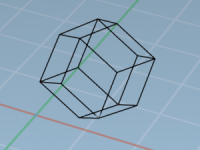
A molecular system can look perfectly isolated on screen and still interact with a copy of itself. That is the periodic-boundary-condition problem: the simulation box repeats in every direction, so a solute placed too close to its boundary may encounter…
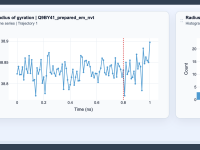
A molecular structure can look dramatically different in a viewer while its overall compactness changes only a little. The reverse can happen too: a modest-looking movement may correspond to a meaningful expansion or collapse. When you need a simple way…
When a molecular scene contains many nodes, a small organizational task can become surprisingly frustrating: finding the property model nodes you want to inspect without confusing them with other kinds of nodes. SAMSON’s Node Specification Language (NSL) provides a focused…