Make Symmetry Work for You: Tips for Visualizing Macromolecular Symmetry

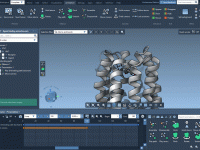
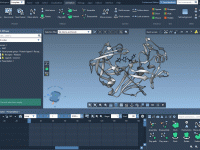
When studying large biomolecular assemblies—such as viruses, protein complexes, or synthetic nanomaterials—symmetry isn’t just aesthetic. Identifying and understanding symmetry can help uncover repeated functional motifs, improve structural validation, and dramatically reduce computational demands. SAMSON’s Symmetry Detection extension brings powerful symmetry…

A Simple Way to Share Molecular Projects with SAMSON Connect

Collaborating on molecular modeling projects often means juggling email threads, cloud drives, file formats, and version mismatches. For molecular modelers, it can be frustrating to share large, complex structural data or simulation results in a streamlined and secure way—especially when…

Clean Exits: Making Molecular Models Disappear Gracefully

When presenting molecular systems to colleagues or students, clarity matters. You want to walk them through a complex structure without clutter, and focus their attention on specific regions. But abruptly hiding parts of a structure can be visually jarring—especially in…

Saving Protein Transition Pathways: Export Options in SAMSON

When working with protein conformational changes, it’s often necessary not only to generate realistic transitions between structures, but also to save and share these transitions for visualization, analysis, or subsequent simulation. If you’re using SAMSON’s ARAP Interpolator to create smooth…

Quickly Show or Hide Labels in SAMSON Using NSL

Labels are a helpful way to annotate and organize structures in molecular modeling projects. But when your scene gets crowded with dozens of them, manual hiding or showing becomes inefficient—especially when you want to highlight just a specific subset. Fortunately,…