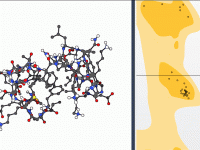
Simplifying Molecular Visualization with Render Preset Attributes
Springboarding to Transition Path Optimization: A Guide to P-NEB in SAMSON

Making Molecular Modeling Visually Intuitive with SAMSON’s Visual Models
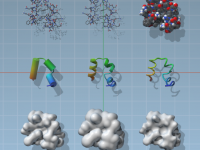
For molecular modelers, understanding and interpreting nanosystems often hinges on clear and effective graphical representations. Whether you’re working with proteins, electrostatic fields, or large biomolecular systems, the challenge isn’t simply to compute or simulate but to visualize your data and…
Mastering Visibility in Molecular Models Using Property Model Attributes
Simplifying Molecular Visualization with Presentation Attributes in SAMSON
Efficient molecular modeling often requires precise visualization and selection of components within a molecular system. For molecular modelers and designers, quickly hiding, showing, or tagging specific elements can make workflows considerably smoother. In SAMSON’s Node Specification Language (NSL), presentation attributes…
Streamline Your Molecular Dynamics Simulations with Easy Input Structure Selection in SAMSON.
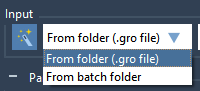
Molecular modelers know that preparing a production molecular dynamics (MD) simulation can be a hurdle, especially when selecting the appropriate input structure. A well-prepared system ensures a smoother simulation process and accurate results. SAMSON’s GROMACS Wizard simplifies this crucial step,…
Understanding Label Attributes in SAMSON’s Node Specification Language
When working with molecular models, clarity and organization are paramount. Molecular modelers often encounter the challenge of managing and organizing nodes effectively during complex projects. SAMSON’s Node Specification Language (NSL) offers a solution with its label attributes feature, designed to…
Enhancing Depth Perception with Ambient Occlusion in SAMSON.
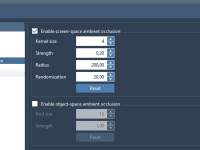
Molecular modelers often face challenges when visualizing complex molecular structures. One key problem is understanding the spatial relationships and depth within a molecule, particularly in dense or intricate models. Without proper depth perception, interpreting molecular data can become a daunting…