Finding Charged Structural Groups in Large Molecular Systems

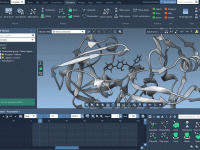
When working with large molecular systems, molecular modelers often need to isolate relevant substructures for visualization, editing, or simulation. One common task is identifying substructures with specific formal charges—whether to locate reactive sites, predict ion binding regions, or prepare input…

Create and Preview Molecular Animations in SAMSON with the Animator

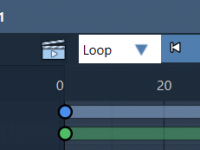
Molecular modelers often need more than static visualizations to communicate complex structural changes, docking processes, or dynamic behaviors. Animations and interactive presentations can significantly enhance clarity, whether you’re prepping material for a talk or sharing insights with a broader audience.…

Choosing the Right Unit Cell Shape Can Save You CPU Time

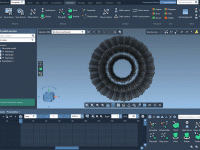
When setting up molecular simulations, especially for solvated macromolecules, an often-overlooked yet crucial detail is the shape of the unit cell. If you’re a molecular modeler working with periodic boundary conditions (PBC), the choice of cell shape can make a…

A Simple Way to Animate Molecular Docking in SAMSON

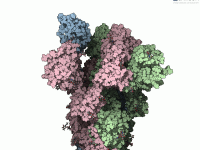
A frequent challenge in molecular modeling is clearly conveying how molecules interact—especially when it comes to docking. Static images can’t capture the nuances of molecular movement, and scripting animations manually can be time-consuming and unintuitive. If you’ve ever wanted a…