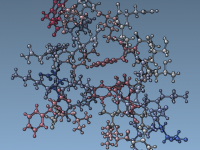
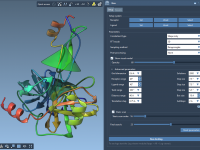
Understanding Molecular Shape Deviation with Asphericity

Molecular modeling often requires a deep understanding of how structures deviate from idealized shapes, especially during simulations or along specific pathways. While measures such as radius of gyration are useful, they may not always capture the complexity of shape variations.…

Mastering Center-of-Mass Pulling in Molecular Simulations

If you’re a molecular modeler dealing with complex simulations, you’ve probably faced challenges in implementing pulling simulations to study inter-molecular interactions or molecular dynamics. In this blog post, we’ll dive into the concept of center-of-mass (COM) pulling, a crucial simulation…

Simplifying Molecular Modeling with NSL Property Model Attributes

Molecular modelers often face significant challenges when managing and specifying property model attributes for their designs. The Node Specification Language (NSL) within SAMSON provides a structured and efficient way to address this issue, offering clear attribute definitions and examples. Let’s…

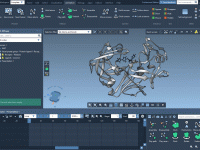
Superimposing Protein Structures with SAMSON’s Protein Aligner

Protein modeling often requires comparing the structures of molecules to identify conserved residues, analyze conformations, or assist in downstream applications like homology modeling. However, aligning protein structures manually can be challenging and time-consuming—especially when precise superpositions are critical. SAMSON’s Protein…

Unlocking the Power of Backbone Attributes in Molecular Design

Molecular modelers often face challenges in pinpointing the exact properties of backbone structures within complex molecular systems. Understanding and manipulating backbone-related attributes efficiently can help facilitate their tasks, whether they are analyzing molecular interactions, optimizing materials, or designing molecular structures.…