Streamlining Molecular Simulations with GROMACS Wizard Batch Computations

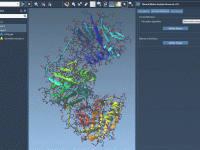
Molecular modelers often face the time-consuming task of running identical simulations on multiple molecular systems or conformations. From umbrella sampling to comparing protein structures, this repetitive setup can feel daunting and error-prone. Enter the GROMACS Wizard Batch Computations feature, designed…
Understanding and Applying Radial Distribution Function (RDF) in Molecular Modeling
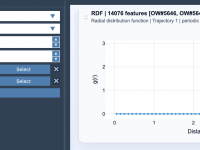
Molecular modelers often grapple with analyzing the spatial organization and interactive dynamics within complex molecular systems. Whether you’re studying solvation structures, local packing around specific groups, or characteristic interaction distances, the Radial Distribution Function (RDF) can be a crucial tool…
Streamline Visual Clarity with the Pulse Animation in SAMSON
Streamlining Your Molecular Modeling Workflow with SAMSON Documents
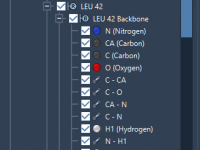
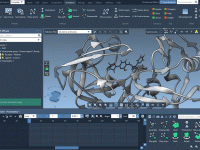
Managing complex molecular modeling projects often involves handling myriad nodes, file types, and structural hierarchies. Inefficient organization can slow down workflows, leading to frustration. Fortunately, the Documents feature within SAMSON simplifies this process by offering a self-contained environment to store,…
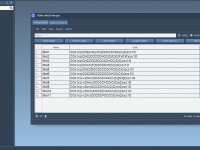
From SMILES to 3D Structures in SAMSON’s SMILES Manager.
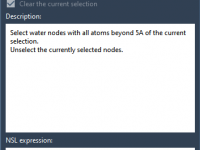
Mastering Node Selection: A Molecular Modeler’s Guide

For molecular modelers, navigating complex atomic-scale structures often starts with one critical skill: selecting the right nodes. Whether you’re working on proteins, nanostructures, or molecular assemblies, understanding and mastering the selection process in SAMSON can significantly streamline your workflow. Let’s…