Skip to content
YouTube Twitter RSS AboutMe Mail
SAMSON Blog
Skip to content
  • Latest posts
  • Get SAMSON

Before an Extension Stops Loading: A Practical Guide to SAMSON Versions

OneAngstrom

A molecular modeling session can depend on more than the SAMSON application itself. You may also rely on extensions for particular tools or workflows. If an extension was built for a different SAMSON SDK version, it may not load in…

From crowded molecular view to clear questions: a practical route through structure analysis

OneAngstrom

A molecular structure can contain far more information than you need to answer one question. You might be trying to inspect a region, compare protein structures, or understand how a ligand interacts with its surroundings. The challenge is often not…

One Coordinate Edit, Many Atoms: Avoiding a Common Selection Mistake

OneAngstrom

Changing the position of several atoms sounds simple—until the whole group loses its shape. In SAMSON, the Inspector lets you edit attributes for selected nodes, but one setting determines whether a position edit preserves the atoms’ relative arrangement or gives…

When a whole-protein fit hides the part you care about

OneAngstrom

Two proteins can be related yet look poorly matched when their full structures are superimposed. That does not necessarily mean there is no useful similarity: the region you care about may align well even when other parts differ. For molecular…

When the Temperature Plot Is Still Moving: A Practical NVT Checkpoint

OneAngstrom

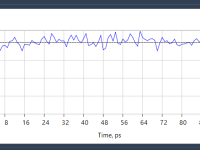
A molecular dynamics run can finish successfully and still leave you wondering: is the system actually ready for the next step? During NVT equilibration, the key question is whether the temperature has settled around its target—not whether every point on…

When a Protein’s Shape Shifts: A Simple Readout for Backbone-State Changes

OneAngstrom

A molecular structure can look reassuringly familiar at a glance while parts of its backbone quietly change state along a path. The challenge is that viewing every frame—or inspecting residues one by one—can make it difficult to see the overall…

When a Molecular View Needs to Travel, Not Just Zoom

OneAngstrom

A molecular animation can be scientifically accurate and still be hard to follow if the camera stays fixed while the viewer’s attention needs to move. A close-up may reveal a region of interest, but a simple zoom does not always…

From Monomer Fragments to a Polymer: A More Manageable Workflow

OneAngstrom

Building a polymer model one fragment at a time can become tedious quickly. Repeating the same unit, tracking where each fragment connects, and checking that the intended bond types are represented all add opportunities for mistakes. Polymer Builder in SAMSON…

The Small Distance Setting That Can Make or Break Coarse-Grained Solvation

OneAngstrom

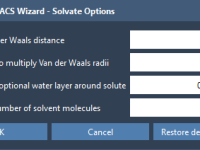
Preparing a coarse-grained (CG) system for molecular dynamics can look straightforward: load the structure, add water, and continue to simulation. But there is an easy-to-miss detail in that sequence. A default solvent distance that works for an atomistic model may…

Before You Simulate: Find and Fix Protein Backbone Outliers

OneAngstrom

A protein structure can look convincing in 3D and still contain backbone conformations worth checking. That matters when you are preparing a model for refinement, simulation, or molecular design: strained or unusual residues may be easy to miss when inspecting…

«‹1516171819›»
  • Subscribe for tips and news

    Check your inbox or spam folder to confirm your subscription.

  • About
  • Privacy Policy
  • Terms of use
  • Contact us
  • Twitter
  • Facebook
  • Back to Top
Powered by Nirvana & WordPress.