A protein–ligand structure can look ready for simulation and still fail during preparation. A common source of trouble is the gap between the ligand as it appears in the structure and the ligand described by its topology: atom names, hydrogens,…
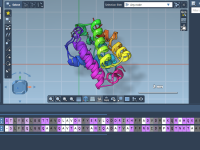
Two protein structures can look different overall even when the part you care about is strikingly similar. The reverse can also happen: a whole-protein superposition may look reasonable while an important helix or binding-site region remains poorly aligned. This makes…
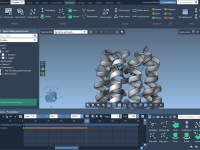
When a molecular trajectory plays, the region you wanted to study can drift out of view. A common reaction is to move the camera repeatedly, but that can make it harder to compare the motion or keep a presentation visually…
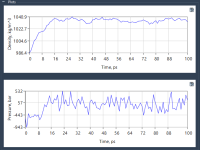
A common moment of uncertainty in molecular dynamics comes after temperature has settled: the system is in NPT equilibration, pressure is fluctuating, and it is not obvious whether the simulation is ready to move on. The useful question is not…
Assembling a molecule from fragments can feel deceptively simple: choose a piece, place it, and connect it. In practice, the difficult part is often knowing whether the connection is sensible, which atom should attach, and how to recover when a…
When a molecular scene contains many kinds of nodes, a broad search can return more than you meant to inspect. Property models have their own Node Specification Language (NSL) attribute space, which gives you a way to keep queries focused:…
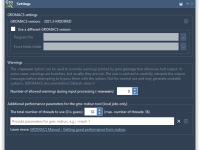
A molecular dynamics setup can be scientifically sound and still be frustrating to run: perhaps your lab uses a specific GROMACS installation, you need to reproduce a calculation with a particular version, or a local simulation makes your computer feel…
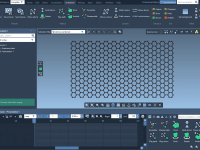
A crystal structure can look deceptively straightforward: open a file, see atoms, and move on. But when you are trying to model a material, a perfect, fully occupied lattice may not represent the structure you actually want to study. Defects…
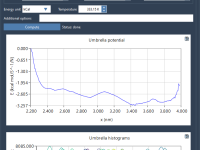
Umbrella sampling can produce many windowed simulations, but turning those separate pieces into a useful picture is a common sticking point. A Potential of Mean Force (PMF) brings the data together along a reaction coordinate. Yet a smooth-looking curve is…
A molecular model can contain more detail than an audience can absorb at once. When you need to explain a binding site, a structural region, or the relationship between selected atoms, leaving every part visible can make the important features…