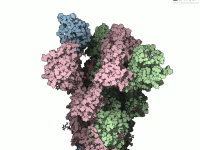
A common challenge in molecular modeling is turning two known protein structures into a useful picture of the motion between them. The endpoints may be available, but they are not necessarily identical in composition or residue count. A simple interpolation…
When a molecular structure contains thousands of residues, a broad visual inspection can quickly become tedious. The challenge is not just finding a residue—it is describing the right one precisely: a particular amino acid, a residue in a helix, or…
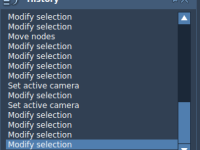
A misplaced move, an unwanted edit, or an experimental transformation can interrupt molecular modeling at exactly the wrong moment. The first instinct may be to repeat the work from memory. But in SAMSON, your document keeps a history of undoable…
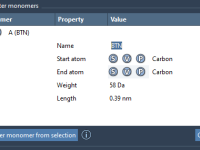
Building a polymer model one unit at a time can become tedious fast. Repeating the same fragment, keeping track of connection points, and expressing different bond types are all small tasks—but together they create plenty of opportunity for mistakes. Polymer…
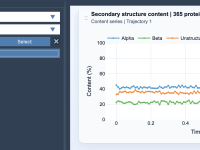
When comparing protein structures along a path, it is easy to miss gradual changes. A helix may shorten, a loop may become more ordered, or one region may shift from beta structure toward an unstructured state—while the overall shape still…
A common modeling problem is local: one region needs to relax, but the surrounding structure should stay where it is. Minimizing the whole molecule can change parts you wanted to preserve, while selecting a few atoms may not do what…
A molecular structure can contain many segments, and the one you need is not always easy to spot by eye. Perhaps you are looking for a long chain, a segment with an unusual atom count, or a segment whose composition…
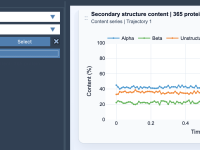
A protein path can contain many frames, and inspecting each structure one by one makes it easy to miss the overall pattern. Did a region gradually lose alpha-helical structure? Did beta content rise along the path? Or is most of…
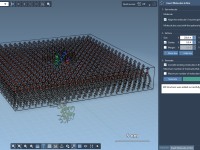
Preparing a molecular environment often means solving a practical packing problem: how can you place many copies of a molecule in a defined space without arranging them one by one? The task becomes more delicate around a protein, where lipids…
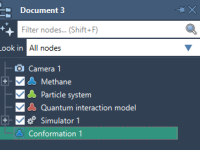
When you adjust a molecular structure, the latest coordinates can quickly replace the arrangement you wanted to compare against. That makes a simple question surprisingly difficult: What did the model look like before that change? In SAMSON, conformations offer a…