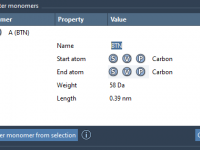
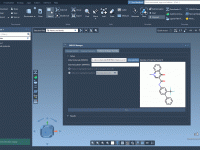
Whether you’re building synthetic materials, biopolymers, or drug-polymer conjugates, custom monomers are often the foundation of the molecular structures you want to model. A recurring challenge in molecular modeling is how to accurately define these monomers and reuse them consistently…
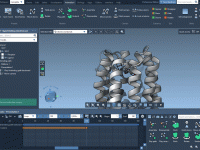
Following dynamic molecular events—like ligand binding or conformational changes—can be insightful, but it often comes with a common frustration: losing track of your region of interest when the scene changes throughout the animation. Molecular modelers know this pain too well.…
For many molecular modelers, the ability to rapidly identify molecules with specific features from a database is essential. Whether you’re looking for potential leads with fluorine groups for binding studies, or aiming to locate analogs containing nitrogen functionalities, the substructure…
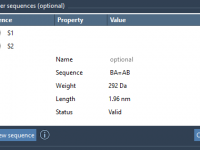
Creating complex polymers often involves repeating monomer patterns, varied bond types, and the need for flexible editing. For many researchers and students in the molecular modeling field, building such custom polymer sequences can feel intimidating — especially when it involves…
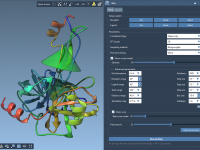
Sometimes, even with a promising homology model, everything just looks right—until you dig into the backbone geometry. Strained or disallowed dihedral angles can hide within your structure, only to show up later in your simulations as instability or poor predictive…
Generating Python scripts for molecular modeling tasks can be time-consuming, especially when switching between documentation, scripting environments, and the visual platform. If you’ve ever wished you could just describe what you want in plain English and get a working script…
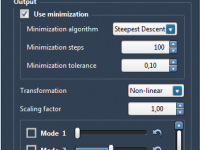
One common challenge in molecular docking is achieving the right balance between search accuracy and computational efficiency. When modeling protein-protein interactions, researchers often want results that are both physically meaningful and delivered in a reasonable amount of time. But how…
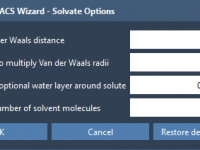
Preparing coarse-grained (CG) systems for molecular dynamics (MD) simulations can often feel like stepping through a minefield of small issues that lead to problematic simulations. One pain point that many molecular modelers encounter is setting up solvation properly when working…
One of the most common bottlenecks in molecular design and cheminformatics is the need to systematically explore chemical space: how do structural modifications at specific molecular positions affect molecular properties like binding affinity or selectivity? Instead of relying on scattered…
When working on molecular presentations, it’s often important to control visual complexity. Whether you’re introducing molecular components one at a time in a classroom, highlighting specific features in a publication video, or creating an instructional animation, clarity matters. One effective…