



Exploring the Shape Parameter for Molecular Design Insights
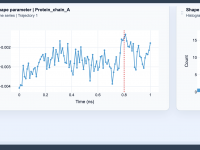
For molecular modelers, the ability to effectively analyze and interpret the shapes of molecular trajectories is crucial, especially when studying complex biochemical processes or designing new molecules. However, traditional shape descriptors like asphericity or radius of gyration might not always…
Highlight and Replace Patterns in Molecules Using SMARTS Codes.
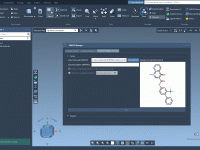
For molecular modelers, efficiently analyzing and generating variations of molecular structures can often be a time-intensive task. Highlighting specific parts of a molecule to explore substitutions or modifications can dramatically accelerate workflows for tasks such as structure optimization or molecular…
Loading Your First Molecular Structure in SAMSON
Mastering Custom Index Groups in GROMACS Wizard

If you’re a molecular modeler working with GROMACS, chances are you’ve encountered scenarios where the default index groups provided during simulations are insufficient for your project. Whether you’re looking to define pull groups, isolate specific residues, or streamline post-simulation analyses,…
Streamline Molecular Workflows with SAMSON Apps
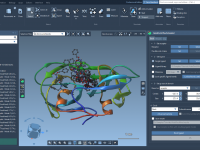
Exploring Defects in Diamond Structures: A Step-by-Step Guide
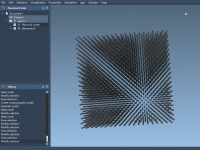
Streamlining Molecular Visualization with Visual Presets in SAMSON
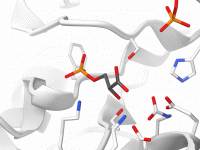
Molecular modelers often need to create visually compelling and informative representations of complex molecular systems. This can involve customizing multiple parameters like visual representations and color schemes—a time-intensive process. Luckily, SAMSON offers a solution: Visual Presets. They allow users to…
Mastering the Universal Force Field Setup in SAMSON
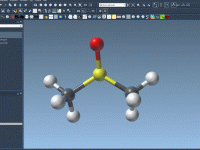
Mastering Interactive Carbon Nanotube Creation in SAMSON

For molecular modelers, nanotechnology enthusiasts, or materials scientists, customizable carbon nanotube (CNT) models are a must-have. But creating these complex structures can be a frustrating challenge if you’re working without intuitive tools. What if you could build single-walled or multi-walled…