Streamline Protein-Ligand Docking with the FITTED Suite in SAMSON

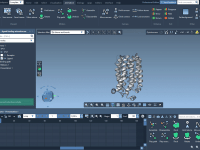
For molecular modelers, setting up protein-ligand docking workflows—whether for covalent or non-covalent interactions—can often be a daunting process, especially when aiming for accuracy and efficiency. The FITTED Suite SAMSON Extension, developed in collaboration with Molecular Forecaster, offers an integrative solution…

Simplify Molecular Modeling with SAMSON’s Molecule Attributes

Molecular modeling can often involve navigating complex datasets and defining precise criteria to study specific molecular properties. SAMSON’s Node Specification Language (NSL) offers an efficient and flexible solution by providing a comprehensive list of molecule attributes for filtering, analyzing, and…

Effortless Residue Selection and Colorization with Sequence View

Understanding and analyzing complex molecular structures can be tricky, especially when trying to identify and interact with individual residues. For molecular modelers, one common challenge is ensuring smooth and precise control over residue selection while maintaining synchronization between the 2D…

Managing Crystal Waters in Molecular Simulations

When preparing molecular systems for simulation, handling crystal waters becomes a critical step. While water molecules are often part of the initial protein structure, not all of them are relevant to your simulation. Mismanaging these waters can lead to unnecessary…

Understanding and Utilizing the Atom Hybridization Attribute in NSL

Molecular modelers often struggle with precisely identifying the hybridization states of atoms within complex molecular structures. This is a critical step in understanding molecular geometry, reactivity, and electronic configuration. Thankfully, the Node Specification Language (NSL) in SAMSON features the atom.hybridization…

Making Molecules Move: The Rock Animation in SAMSON

In molecular modeling and simulations, visualizing molecular motions can provide crucial insights into the behavior and interactions of complex systems. Yet, how often do you struggle to easily represent dynamic movements, such as oscillations or rocking motions? If this rings…