Exploring Mesh Attributes in SAMSON’s Node Specification Language
For molecular modelers and computational scientists, having granular control over visual and functional components of molecular models can sometimes feel challenging. In SAMSON’s Node Specification Language (NSL), Mesh Attributes provide a straightforward way to manage mesh nodes effectively. Whether it’s…
Building Your Own SAMSON Extensions: A Guide for Molecular Modelers
Streamlining Molecular Visualizations with the Appear Animation in SAMSON
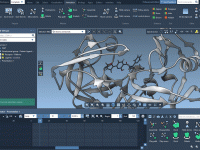
When working with molecular modeling and design, creating clear and dynamic visualizations can significantly improve communication and understanding, whether you are presenting findings to colleagues or explaining complex structures to a broader audience. One frequent challenge is to effectively highlight…
Effortlessly Rotate Particle Groups in Molecular Models
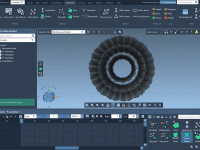
Mastering Mesh Attributes in SAMSON
For molecular modelers delving into the SAMSON Integrative Molecular Design platform, efficiently managing and understanding mesh attributes in SAMSON’s Node Specification Language (NSL) can improve workflows significantly. Whether you’re working on structural analysis, visualization, or custom scripting, knowing how to…
Efficiently Setting Up NPT Parameters in GROMACS Wizard

One of the common challenges in molecular modeling is ensuring that simulations are configured correctly, especially during equilibration steps. A crucial stage is the NPT equilibration, where the system density stabilizes under constant pressure and temperature conditions. Misconfigured parameters during…