A molecular modeling project rarely stays on one computer. You may need a colleague to inspect a published structure, a project group to access shared materials, or a collaborator to retrieve files from a cloud job. The tricky part is…
You have framed a molecular system just right: the feature of interest is visible, the orientation makes sense, and the view is ready for a presentation. Then you continue working on the document, and the camera changes. In an animation,…
When a molecular scene gets busy, it can be surprisingly difficult to answer a simple question: which presentation nodes are visible, hidden, or selected? Searching by memory—or clicking through objects one at a time—interrupts the modeling task. SAMSON’s Node Specification…
Large molecular structures can be difficult to inspect one piece at a time. A useful first step is to narrow the structure by segment: for example, find segments with a certain number of residues, check which ones are unusually large,…
A familiar modeling task can become unexpectedly frustrating when a file opens in one tool but not another—or when you discover that the format you need to export is not the format you can import. The first useful question is…
When a molecular structure contains several chains, choosing the right one by eye can be slow—and chain IDs alone may not tell you which chain is the long polymer, a short fragment, or a structure split into multiple segments. SAMSON’s…
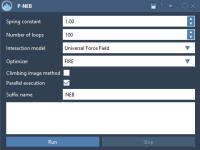
A molecular transition path can look plausible and still contain awkward jumps, unevenly spaced structures, or intermediate conformations that need refinement. That is a common problem when you have generated a candidate route between two states and now need to…
A force-field setup can fail for a frustrating reason: the selected parameters may be suitable for one part of a structure but not another. A protein–ligand complex, for example, may need biomolecular parameters for the protein and a separate force…
If you perform the same molecular-modeling task repeatedly, the work can become harder to trust as well as harder to finish. A sequence of manual steps may be easy to follow once, but later it can be difficult to remember…
When a molecule needs a new substituent or a different linker, the tedious part is often not imagining alternatives—it is making each edit consistently. Rebuilding the same scaffold over and over can invite mistakes, especially when you want to compare…